
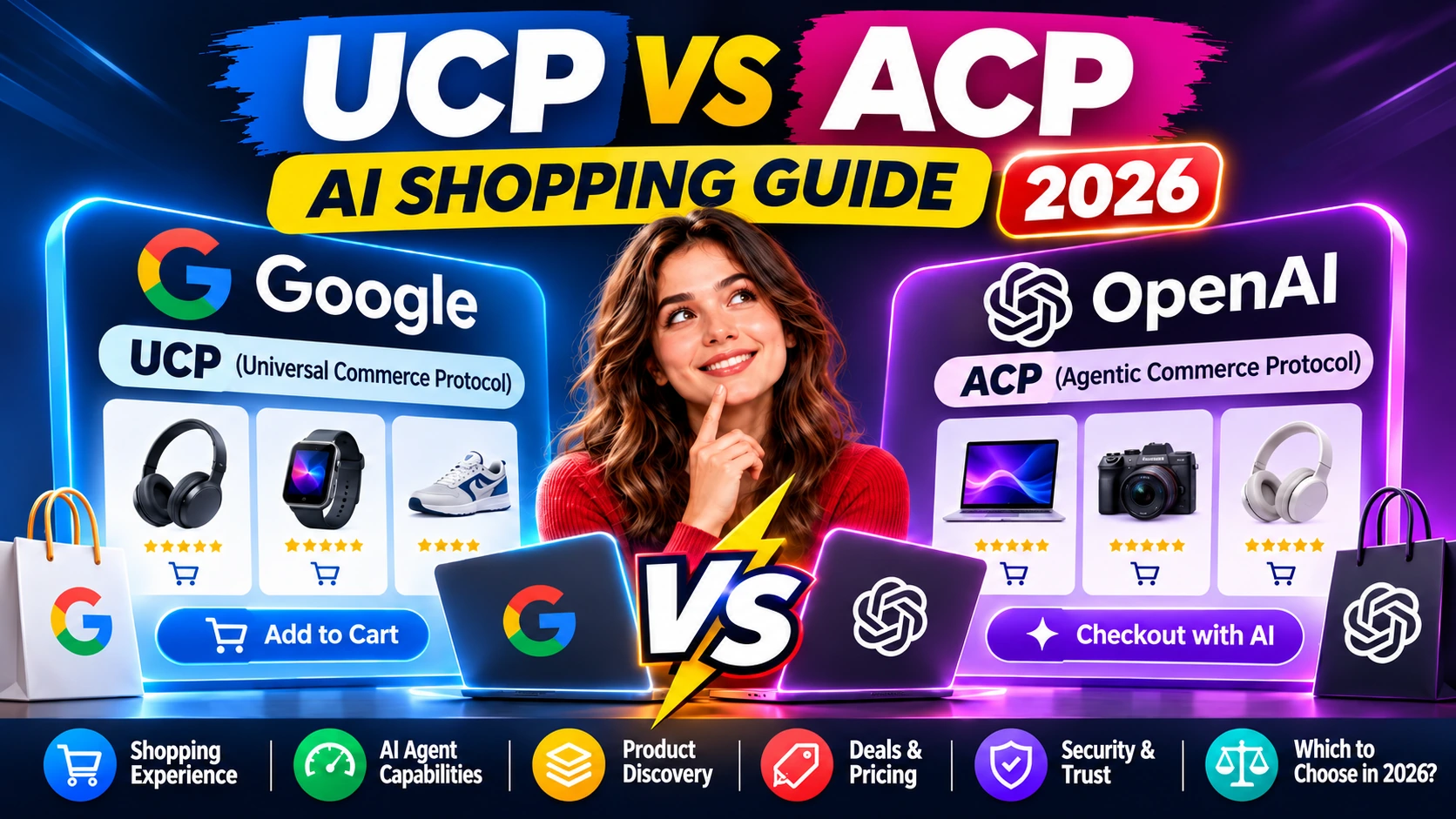
UCP vs ACP in 2026: As AI assistants become shopping companions, retailers want to know whether Google’s Universal Commerce Protocol or OpenAI’s Agentic Commerce Protocol deserves their attention. This guide explains both approaches, compares merchant onboarding, and provides a 12-point checklist for Shopify, WooCommerce and custom stores. It separates protocol capabilities from real-world eligibility and ranking claims.
Updated November 21, 2026. Merchant features, protocol specifications and geographic availability may change; confirm official documentation before implementing checkout.
Google UCP vs OpenAI ACP: what is the difference?
Google UCP vs OpenAI ACP is a comparison between two emerging approaches to AI-assisted product discovery and purchasing. UCP stands for Universal Commerce Protocol, an open standard Google announced with retail partners in January 2026. ACP stands for Agentic Commerce Protocol, an initiative associated with OpenAI and partners that underpins commerce experiences in and around ChatGPT. Both aim to make products and transactions easier for AI systems to understand, but their merchant integration paths and current shopping surfaces differ.
The distinction matters to online stores because appearing in an AI shopping answer is not the same as completing an order. Product discovery requires accurate inventory, structured descriptions, shipping and return information. Checkout also requires identity, payment authorization, fraud checks, taxes, fulfillment and support. A store should not assume that connecting to one commerce standard automatically guarantees visibility or eligibility in every AI assistant.
This guide explains the public documentation available on November 21, 2026. Implementation details are changing quickly. Google’s official UCP guide and OpenAI’s ChatGPT product-discovery announcement are the primary starting points.
UCP vs ACP: comparison table for ecommerce teams
The comparison below separates technical scope from what an individual retailer may actually qualify to use. Eligibility can depend on commerce platform, merchant account, region and product category.
| Question | Google UCP | OpenAI ACP |
|---|---|---|
| Primary ecosystem | Google shopping, AI Mode and related Gemini experiences | ChatGPT product discovery and supported merchant flows |
| Launch context | Google announced UCP in January 2026 | OpenAI described ACP in 2025 and expanded discovery in 2026 |
| Merchant starting point | Merchant Center and UCP integration documentation | Supported ecommerce integrations and product-data availability |
| Broad design | Discovery, checkout and order-life-cycle capabilities | Protocol-backed product discovery and commerce integrations |
| Does it replace store operations? | No: merchants still manage orders, refunds and policies | No: merchants remain responsible for product and fulfillment accuracy |
| Does using it guarantee visibility? | No | No |
| Best initial action | Check feed quality, Merchant Center and program eligibility | Check catalog accessibility, supported partners and current merchant process |
Because platform rules evolve, avoid generic claims that all merchants can activate an in-chat purchase button today. A protocol specification describes a technical mechanism; product rollout is an operational decision made by the platform and merchant partners.
Google Universal Commerce Protocol: what it enables
Google introduced UCP as a way for agents and merchants to support parts of the shopping journey through common specifications. Google’s January announcement describes discovery through purchase and post-purchase support. The developer guide includes preparation for Merchant Center, UCP profiles, checkout capabilities, payment integrations, order-life-cycle flows and analytics.
For a retailer already using Google Merchant Center, the initial preparation is less glamorous than a new AI feature. Product IDs, titles, prices, availability, variants, policies and landing pages need to agree. If a product feed says a shirt is in stock but the store says it is unavailable, the customer experience fails regardless of the checkout protocol. Fixing data consistency is a sensible first step.
The UCP documentation describes capability discovery and merchant preparation. Merchants should check current eligibility and technical prerequisites rather than deploying copied example requests into production. Payment systems and order updates have security and compliance implications; use supported integrations, sandbox accounts and the store’s existing operational processes.
Google’s UCP latest-updates page records changes to the integration guidance. Treat this page as the maintained source for specification revisions, not a static third-party tutorial.
OpenAI ACP: product discovery and merchant responsibilities
OpenAI introduced its Agentic Commerce Protocol initiative in 2025 in connection with purchasing experiences in ChatGPT. In March 2026, OpenAI described richer product discovery and connections with ecommerce merchants, including Shopify businesses. The documented experience and merchant options have continued to evolve, so older launch-day descriptions may not reflect current behavior.
For a merchant, the most important question is where accurate product facts originate. A shopper asking an AI assistant to compare products needs current prices, reliable variants, shipping information and reasons to trust the store. A product feed or supported integration may supply those details, but a merchant should verify what its commerce platform actually exposes. An AI description should not invent reviews, stock levels or delivery claims.
OpenAI’s original ACP announcement provides historical context, while the later product-discovery update is relevant to the broader shopping experience. Compare the latest support information from the actual merchant platform before investing in custom checkout code.
An important practical point: if a business is not currently eligible for a particular commerce integration, it can still improve its ordinary product pages, catalog completeness, shipping policies and customer service. Those changes help humans and traditional search as well as automated product understanding.
Does an AI shopping protocol improve Google rankings?
A commerce integration is not a guarantee of SEO rankings, inclusion in AI answers or conversion. Search systems consider many signals, and the platforms do not promise that a compliant merchant will receive free traffic. UCP and ACP are related to product data and commerce capabilities; a site still needs accurate descriptions, useful category pages, functioning links and trustworthy checkout experiences.
Start with basics that both humans and search engines can understand. Use descriptive product titles rather than keyword stuffing. Show real photographs with appropriate ALT text and clear attributes. Display a consistent price and currency. Explain shipping cost and expected delivery before the final purchase. Keep returns, support contacts and stock information current.
For product-rich content, technical teams can review Google’s ecommerce search guidance, which covers product discoverability and structured data. These general Search recommendations are distinct from UCP program eligibility. Do not say that adding structured data automatically activates UCP or a checkout feature.
Our Google AI Overviews SEO guide explains broader content visibility, while this article concentrates on AI-readable commerce and product data. The two topics overlap but are not substitutes.
12-point merchant checklist for Google UCP and OpenAI ACP
Before asking a developer to connect a shop to an AI agent, check the fundamentals. A clean catalog reduces the number of places where an assistant can provide a wrong recommendation.
- Product identity: Use stable IDs and clear names for every product and variant.
- Availability: Keep live stock values and feed status consistent across channels.
- Price and currency: Confirm total product price, taxes and shipping terms where applicable.
- Shipping: Publish accurate fulfillment regions, timing and fees.
- Returns: Make cancellation, refund and return policies easy to find.
- Product media: Use original or properly licensed images that match the exact variant.
- Product facts: Include materials, sizes, compatibility and limitations where relevant.
- Checkout security: Use approved payment integrations, not homemade storage of card data.
- Merchant eligibility: Verify whether your platform, geography and account qualify for each program.
- Permission boundaries: Ensure any shopping agent accesses only the required operations.
- Customer support: Define who handles order mistakes, refunds and post-purchase questions.
- Analytics: Track real traffic, completed orders, returns and customer satisfaction.
This checklist cannot guarantee approval by Google or OpenAI. It helps a merchant prepare useful evidence and avoid expensive integrations built on unreliable source data. Treat each protocol’s latest documentation as authoritative for its actual requirements.
Google Merchant Center setup: a sensible first workflow
If you sell physical products through an eligible store, create or review the Merchant Center account that represents the business. Verify ownership and key business details according to Google’s process. Check product feed diagnostics, shipping and return configurations, and any errors that prevent products from appearing in ordinary shopping experiences.
Next, map product data fields to the store platform. Validate a few varied examples: a product with sizes, one with limited inventory, one with a sale price and one with a complex shipping restriction. Confirm that the public product page agrees with the submitted feed. Before working on an advanced checkout integration, test whether this basic merchandising information is complete and fresh.
Then review Google’s UCP merchant preparation documentation. Some steps may be performed by a supported ecommerce partner rather than the retailer directly. A small merchant should not build a custom protocol adapter unless the expected value justifies engineering and ongoing maintenance.
Keep a dated record of eligibility checks and failed validation tests. Commerce protocols are evolving, so a clear baseline makes later changes safer. For general catalog and conversion considerations, read our AI website-builder buying checklist, noting that affiliate publishers and merchants have different responsibilities.
Shopify, WooCommerce and custom stores: where to begin
Shopify: Review Shopify’s supported merchant and shopping integrations in your region. Determine which product data is already shared through sanctioned integrations and whether any additional merchant enrollment is required. Avoid adding a second app that duplicates a working feed without understanding its effects.
WooCommerce: Ensure product attributes, variants, taxonomy, structured data, inventory synchronization, payment methods and shipping policies are correct. Use supported plugins and verify their data handling. Do not assume a generic WordPress search-optimization plugin automatically connects the store to ACP or UCP.
Custom storefront: Separate catalog data, order management, payment processing, identity and presentation. An integration should read authoritative pricing and inventory rather than generating them from a language model. Use an isolated staging environment and an explicit release process for any agent-mediated checkout.
In every case, the merchant remains responsible for satisfying buyers. A successful technical demo is not proof that returns, tax handling, fraud reviews or customer communications will work at scale.
Example: prepare a 50-product store for AI shoppers
Imagine a small home-goods shop with 50 active products. Its inventory system shows the correct price, but ten product pages use outdated delivery estimates and seven have confusing variant names. The owner wants more discovery through AI shopping. A protocol integration could expose those same inconsistencies to another channel.
The team first fixes product titles, prices and variants. It updates delivery and returns information, verifies the business contact page and checks payment flows with a test order. After that, it reviews Google Merchant Center diagnostics and the supported OpenAI merchant route. The business chooses an integration only when it knows which program it qualifies for and how orders will be managed.
The shop then tracks qualified traffic, add-to-cart behavior, completed purchases and refunds by source where its analytics permit. It does not assume an AI agent sent every customer who mentions ChatGPT, nor does it claim sales growth without actual measurements.
This example is fictional and intended to show operational sequencing. The most expensive mistake is often not choosing UCP instead of ACP; it is exposing poor product data and unclear payment processes to another shopping surface.
Which integration should a business prioritize?
The choice depends on the surfaces your customers use and the commerce stack you operate. Businesses that already depend on Google Merchant Center should prioritize catalog quality and review UCP readiness as part of their existing Google commerce workflow. Businesses serving customers who research products in ChatGPT should monitor OpenAI’s current supported merchant discovery paths.
A merchant does not necessarily need to choose one standard forever. The ecosystem may support several, but integrations require maintenance, policy review, credentials, analytics and customer service. Add the next channel only when you can support it reliably.
| Your situation | Practical first step |
|---|---|
| New store, incomplete product catalog | Fix products, policies, checkout and ordinary SEO |
| Established Google Shopping merchant | Check Merchant Center diagnostics and UCP eligibility |
| Shopify merchant interested in ChatGPT discovery | Review supported platform integrations and current OpenAI guidance |
| Custom enterprise store | Map protocol requirements to authoritative commerce APIs |
| Affiliate-only publisher | Improve disclosures and accurate reviews; do not claim merchant checkout access |
For businesses selling AI software, also consider whether product comparisons provide original evidence and accurate pricing. This Google UCP vs OpenAI ACP guide is a technical readiness comparison, not an advertisement that either program will automatically produce leads.
Privacy, fraud, payments and human approval
AI shopping can involve customers’ preferences, location, order details and payment authorization. Merchants should understand which party processes each data element and the responsibilities they retain. A secure design keeps card handling with an appropriate payment provider, applies risk checks and does not give an assistant unrestricted order-management authority.
Do not treat a model-generated confirmation as proof that a payment succeeded. Use the payment processor’s authoritative transaction status and your commerce system’s order records. Similarly, an assistant saying an item will ship tomorrow should not override the warehouse’s actual availability or service-level promises.
Support staff need an escalation route when an agent makes a mistaken recommendation or a buyer disputes an order. Maintain transparent returns and contact methods. For a broader question set covering provider contracts, subprocessor access and unexpected model behavior, consult our AI vendor risk assessment guide.
Frequently asked questions about UCP vs ACP
Does Google UCP replace Google Merchant Center?
No. Google’s developer guidance describes Merchant Center as a starting point for product feeds and UCP readiness. Exact program steps depend on the supported integration.
Does every ChatGPT user see the same shopping checkout?
No. Merchant participation, region, product category and product changes can affect the available experience. Check current OpenAI and commerce-platform guidance instead of assuming every checkout feature is universal.
Which protocol is better for a Shopify store?
Start with the platform’s supported integrations and your customer’s shopping channels. Reliable catalog data and order handling matter more than implementing a protocol manually for its name.
Will implementing ACP or UCP increase my organic traffic?
Neither protocol guarantees impressions or purchases. Treat merchant eligibility, product quality, search visibility and conversion as separate measurements.
Can WooCommerce stores use these standards?
Support depends on current tools, partners and program requirements. A WooCommerce store can prepare good product data and checkout systems now, but should verify specific integrations before deployment.
What is the first thing a small retailer should do?
Audit product data and policies, fix payment and shipping inaccuracies, and review the official program requirements. Avoid building custom checkout infrastructure before confirming eligibility and business value.
Final verdict: start with trusted product data
The most useful Google UCP vs OpenAI ACP conclusion is that both connect AI shopping to commerce infrastructure in different ways. Google’s UCP emphasizes a broader commerce specification and Merchant Center preparation. OpenAI’s ACP supports its evolving ChatGPT product-discovery and commerce experiences. Product rollout, merchant eligibility and partner implementations matter as much as the protocol architecture.
If your store has missing prices, unclear inventory and weak policies, fix those first. Then evaluate which shopping surfaces send relevant customers and whether the official integration path supports your business. This approach produces better foundations for traffic and trust even if AI shopping platforms change next quarter.
Editorial disclosure: Information was reviewed November 21, 2026 using the official Google and OpenAI announcements and developer documentation. Examples are illustrative. AI Review Dock does not claim to have enrolled a test merchant in either program or measured sales improvements.