
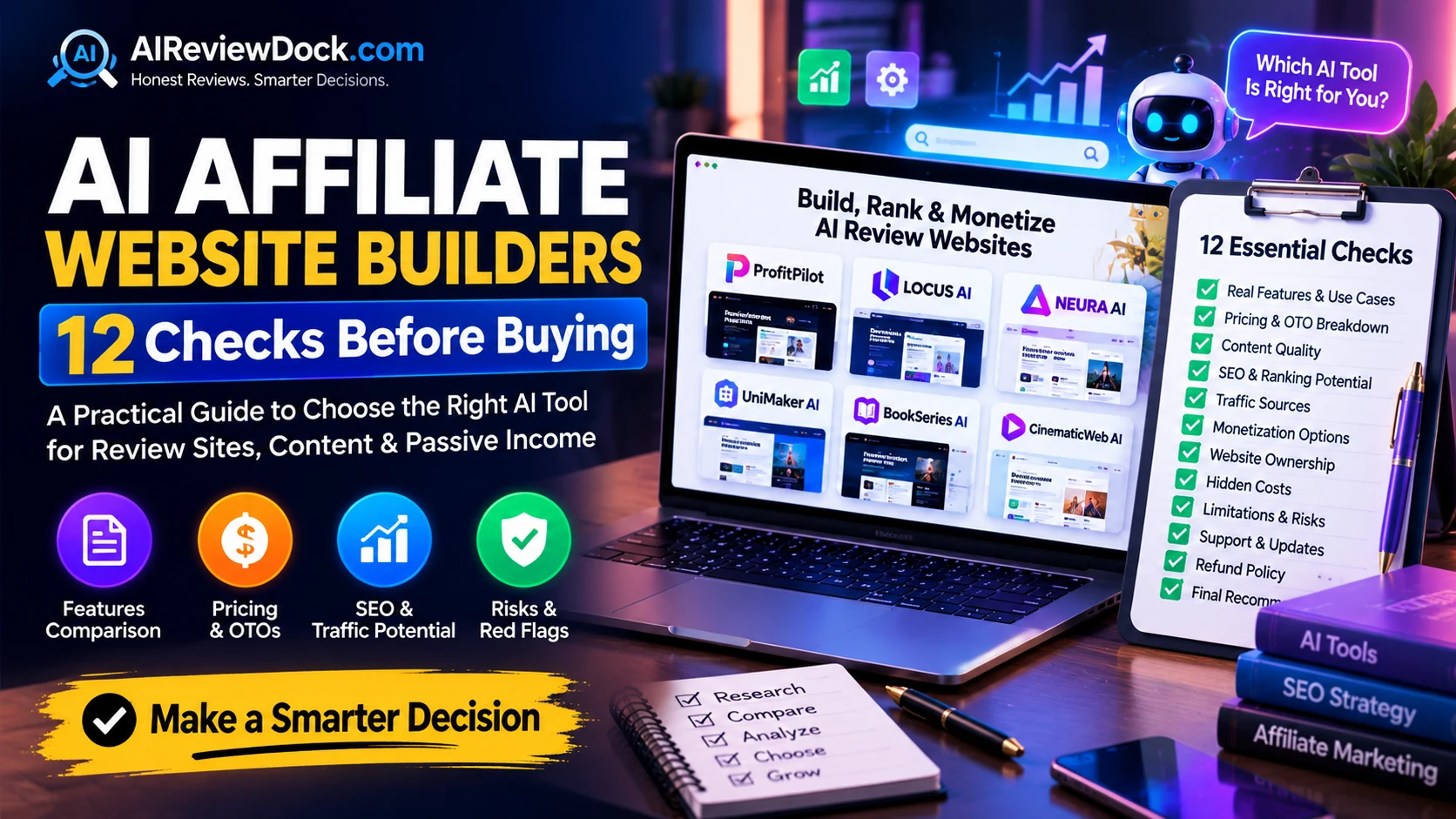
Quick answer: AI affiliate website builders can help organize templates, product information and publishing workflows. They cannot independently verify a seller’s promises, create genuine testing experience or guarantee search traffic. The smartest buying decision is to evaluate the platform’s accuracy, site ownership, affiliate tracking and long-term control before paying.
New launches regularly promise a review site from a single prompt. That sounds appealing to someone who wants to compare AI products, software or creator tools, but the more important question is not how fast a homepage appears. It is whether the resulting website serves readers, keeps tracking links correct, and remains usable if the vendor changes its pricing or shuts down.
This guide is a vendor-neutral evaluation framework for AI-assisted affiliate review site builders. It does not rank or endorse any specific software; offers, prices and demonstrations should be checked independently.
What Does an AI Affiliate Review Website Builder Actually Do?
In this category, platforms commonly advertise site templates, AI-generated product descriptions, review blocks, CTA placement, hosting and some degree of publishing automation. Individual products vary enormously. A tool that drafts a review and inserts a button is not necessarily a full SEO platform, analytics system or long-term hosting service.
For context, newly launched tools such as ProfitPilot have been marketed through affiliate product-launch calendars as simplified review-site builders. That illustrates the category, not a recommendation. The framework below can be applied to that or any competing offer without assuming its claims are true.
The 12-Point Buyer Checklist
1. Confirm exactly what the basic purchase includes
Ask for a written list of the number of websites, monthly reviews, generated images, visitors, storage and allowed campaigns. ‘Unlimited’ in advertising may still have resource, abuse-prevention or account limits. Check if upgrades unlock basic publishing features you assumed were included.
2. Verify who owns the website and domain
Use a domain registered in your own account whenever possible. Confirm whether you can map a custom domain, control DNS records, retain URL slugs and export the site if you leave the service. Losing your domain or review archives is a far more serious risk than losing one layout template.
3. Ask for a complete content export
A platform should provide an understandable way to retrieve text, images, internal-link structure and metadata. Ask whether exports produce plain HTML, a WordPress-compatible format or only a vendor-specific package. Do not assume a built-in custom-domain feature includes migration.
4. Demand real editorial control
Reviewers need to edit every key fact: price, credits, supported devices, license type, refund terms, limitations and direct alternatives. An automated article editor should permit manual correction before publishing and a record of updates afterward.
5. Separate vendor claims from firsthand testing
AI can rewrite sales-page material, but it cannot truthfully claim ‘I used this for seven days’ unless there was a real test. Keep a clear methodology note and label unverified feature claims. When screenshots or customer outcomes are unavailable, say so rather than inventing proof.
6. Check affiliate link ownership and tracking
Beyond checking link ownership, create a repeatable validation workflow. Our affiliate link tracking checklist covers redirects, campaign tags, conversions and broken-link checks without relying on a website-builder’s marketing claims.
Paste one approved affiliate URL, publish a test page and verify where the CTA actually leads. Ensure tracking parameters are preserved, expired offers can be replaced safely and a platform does not secretly insert its own account. Do not mix up product page links with approved commission-bearing links.
7. Include clear affiliate disclosures
For readers who may purchase through tracked links, disclosure should be understandable and prominent near relevant recommendations. The FTC’s endorsement guidance explains why the words ‘affiliate link’ alone may not clearly communicate compensation. Follow the laws and network terms applicable to your audience.
8. Test mobile page quality
Check the page at narrow viewport sizes. Product specifications, pros-and-cons tables and CTA buttons must be readable without horizontal scrolling. Review image dimensions, font sizes, navigation, keyboard use and loading behavior. An attractive desktop demo is not proof of a usable mobile website.
9. Audit indexability and essential SEO controls
Look for editable titles, meta descriptions, canonical URLs, sitemap generation, sensible navigation and a clean page structure. Make sure pages are not accidentally noindexed. Even with perfect technical settings, rankings still depend on original value, competition and users’ needs. Our Google AI Overviews SEO guide covers the larger search context.
10. Check content originality at scale
Publishing fifty AI-written descriptions of near-identical products is not the same as producing fifty useful reviews. Build each piece around a distinct problem, verifiable facts and decision criteria. Google’s guidance on generative AI content cautions against mass-producing pages with little added value.
11. Evaluate privacy, security and support
Affiliate publishers may share tracking IDs, connected accounts and commercially sensitive information with a site builder. Ask what information the provider stores, whether accounts have two-factor authentication, what happens after a breach, and how to contact support. See our separate AI software privacy checklist for a deeper assessment.
12. Calculate the true two-year cost
Add the initial purchase, useful upgrades, domain renewals, optional hosting, email, image generation, maintenance, migration and platform fees. A low entry price may be excellent value—or an incomplete estimate. Compare the total with a conventional website setup. Our lifetime deals versus subscriptions guide provides more detail.
Use a Sample Review to Test a Platform
Before building a whole site, evaluate one ordinary product-review page. For example, try a software product with publicly available official terms and at least one legitimate competitor. The platform should not need dozens of published pages to show you whether its templates are usable.
| Sample test | Pass condition |
|---|---|
| Import product URL | No invented features, support channels, discounts or subscription terms |
| Edit review | All key facts, title and link labels can be corrected |
| Add tracking | Approved affiliate URL opens without substitution |
| Add alternatives | Comparisons explain meaningful differences instead of invented rankings |
| Mobile viewport | Navigation, tables and CTA remain legible |
| SEO inspection | Correct canonical and indexability, readable page structure |
| Export | Content and important metadata are available in a portable form |
What Search Engines Can and Cannot Reward
A tool can help you place headings, internal links, images and metadata correctly, but there is no legitimate automatic route to guaranteed first-page rankings. Review quality improves when a writer explains the evaluation method, offers original comparisons and addresses real purchase risks. Google’s helpful-content guidance asks publishers to prioritize original, accurate, people-first information rather than bulk production for search traffic.
A useful review can tell the buyer what remains untested. A page claiming superior performance, income or compatibility without evidence is less useful—even if its title and SEO score look perfect.
AI Builder vs Traditional WordPress
| Factor | Managed AI builder | Self-hosted WordPress |
|---|---|---|
| Setup effort | May be lower, depending on vendor | Requires hosting/theme configuration |
| Editorial workflow | Depends on editing and approval features | Flexible with suitable roles and plugins |
| Affiliate integrations | Must verify each network | Managed through content/plugins |
| Content portability | Vendor-specific; must verify | Standard WordPress export and backups |
| Page speed | Depends on actual hosting/templates | Depends on hosting, theme and optimization |
| Search rankings | Never guaranteed | Never guaranteed |
Common Red Flags
- Promises of first-page rankings in hours or automatic passive income from a blank site.
- Product ratings without a documented evaluation method.
- No answer about exporting site content or controlling your domain.
- Upsells that unexpectedly unlock basic editing, backups or affiliate tracking.
- Shared ‘done-for-you’ articles that many buyers publish verbatim.
- No reliable instructions for updating or removing obsolete promotional claims.
- Unavailable customer support and vague refund exclusions.
A Practical Publishing Workflow
- Choose one narrow audience and buyer problem.
- Collect official product details, legal terms and a dated price snapshot.
- Use AI for an outline or first draft, but verify all facts manually.
- Explain what was tested, what was not, and how the conclusion was reached.
- Add approved affiliate CTAs only after confirming tracking and disclosure.
- Link to genuinely relevant guides and comparisons. For example, see our AI agents vs workflow automation explainer.
- Check mobile presentation, image size, indexability, speed and spelling.
- Publish only when the page adds useful information that a sales page does not.
- Review Search Console query data and refresh expired facts when needed.
FAQ: AI Review-Site Builders
Can an AI website builder rank affiliate reviews on Google?
It can produce pages that may be indexed, but ranking depends on many factors including competition, original usefulness and site reputation. No tool can guarantee a specific position.
Are AI-generated product reviews allowed?
AI assistance is not automatically prohibited. Accuracy, originality, transparency and search spam policies still apply. Avoid fabricated product testing or scaled low-value pages.
Should I choose the cheapest front-end offer?
Not necessarily. Compare the actual limits, support, upgrade requirements and content ownership over time.
What matters more than an SEO score?
Reliable information, a clearly explained buyer decision, original evidence, useful navigation and actual impressions and conversions.
Do I need a separate affiliate account?
Yes, ordinarily a valid, approved network relationship is necessary for you to earn commission. Site builders do not automatically grant program approval.
Conclusion
An AI affiliate review builder is worth evaluating as a workflow tool—not as a substitute for product research, compliance or audience building. Before buying, test one page, confirm tracking and portability, then compare the cost of ownership. The best option is the one that allows you to publish accurate, distinctive reviews that you genuinely control.
Editorial method: This is an educational checklist compiled from published Google Search Central and FTC guidance, practical publishing requirements and common buyer-side evaluation questions. It is not a hands-on endorsement of a specific vendor.