
AI vendor risk assessment checklist (2026): Before paying for an AI assistant, connecting it to company data or deploying an autonomous workflow, check the vendor’s security, model transparency, data retention, human oversight and contract terms. Moreover, this practical buyer guide provides 25 questions, a weighted scorecard and a small-team evaluation workflow.
Updated November 19, 2026. This original questionnaire is educational procurement guidance. It is not an official NIST certification, audit opinion or legal compliance determination.
What is an AI vendor risk assessment?
An AI vendor risk assessment checklist is a documented review of the information, access, behavior and contractual obligations involved when an organization buys or connects an AI service. Unlike a generic software-security questionnaire, it also examines model behavior, prompt retention, generated output, third-party model routing and autonomous actions.
Moreover, small companies need this process as much as large procurement teams. For example, a business might adopt a note-taking app that summarizes customer meetings, an AI assistant that drafts responses, or a coding agent that can edit production repositories. Those products have different consequences even if they are sold at similar prices. The review should be proportional to the actual use case.
However, a vendor checklist does not prove compliance or guarantee safety. Instead, it gives an owner a repeatable way to decide whether to approve a pilot, impose restrictions, seek evidence or reject a proposed workflow. The questions below are original buyer prompts informed by recognized risk-management themes, especially NIST’s AI RMF Playbook.
Before you assess a vendor, define the use case
A risk score without context can mislead. Start by describing the business task in one sentence, such as ‘summarize publicly available research for internal brainstorming’ or ‘draft customer replies using support tickets’. Record the people who can use the system, data it can access, integrations it requires and the effect of an incorrect response. Identify a named business owner.
Next, decide which failure would matter most. For example, a public content tool may introduce reputational or copyright concerns; an HR screening tool could affect people in consequential ways; a customer-service agent may create an unauthorized commitment if it sends messages without approval. The more consequential the workflow, the more evidence and controls the assessment needs.
Furthermore, record whether the tool is a standalone product, a feature in an existing platform or a service that routes requests through several external models. A vendor’s website may describe capabilities at a product level while specific data-handling terms apply only to a particular plan, region or configuration. Ask for the exact offering you intend to purchase.
AI vendor risk assessment checklist: 25 buyer questions
Next, compare vendors using the same evidence-based questions. However, treat the scorecard as a decision aid rather than a security certification.
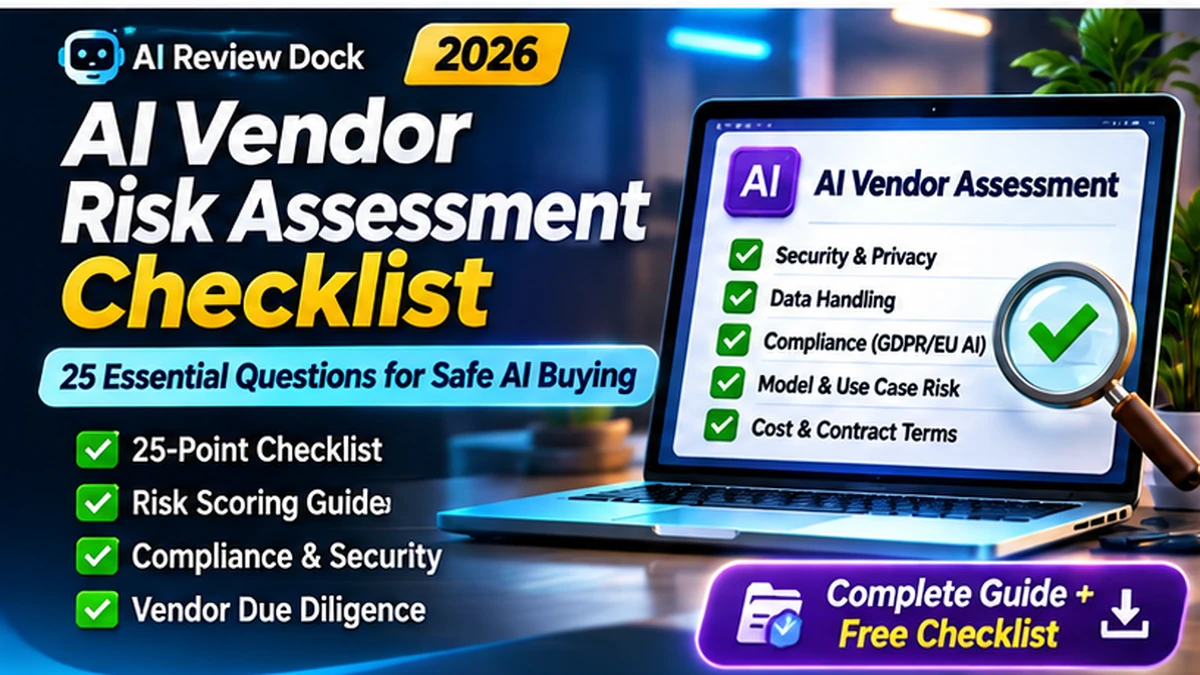
Use these 25 questions in a vendor questionnaire or during a sales demonstration. Moreover, written answers are more useful than a checked box saying ‘enterprise-ready’. Request evidence proportionate to the risk and note when a feature is unavailable in the proposed tier.
Group A — Governance and model transparency
- Purpose: Which tasks is the product designed to perform, and which uses does the vendor explicitly discourage?
- Model identity: Which underlying models, versions and providers process our requests?
- Subprocessors: Which other companies receive data or operate parts of the service?
- Change process: How are model swaps, feature changes and major safety updates announced?
- Accountability: Who receives and resolves customer reports of harmful behavior or unexpected output?
Group B — Data handling and privacy
- Training use: Does the vendor use submitted prompts, files or outputs to train or improve models? What controls or contracts apply?
- Retention: How long are prompts, uploads, metadata and logs stored, including backups?
- Deletion: How can a customer delete data, and what exceptions or delays remain?
- Geography: Where does the vendor process or store information, and can customers choose the location?
- Data rights: What permissions does the vendor claim over uploaded material and generated outputs?
Group C — Security and access
- Identity: Are single sign-on, multi-factor authentication and role-based access supported?
- Connections: Which permissions does the service request for email, drive, CRM, source code or other integrations?
- Secrets: How are API keys, tokens and credentials stored, rotated and revoked?
- Independent assurance: Which current audit reports, testing results or certifications will the vendor share for this service?
- Incident handling: How and when are customers informed about security events affecting their data or services?
Group D — AI behavior and oversight
- Accuracy: What evidence describes performance on the tasks we intend to use?
- Prompt injection: How does the product handle malicious instructions inside untrusted pages, files or messages?
- Human approval: Can a person review important outputs and approve actions before they run?
- Logging: What useful activity history is available without exposing unnecessary personal information?
- Safeguards: What happens when the system is uncertain, produces an error or reaches a usage limit?
Group E — Contract, operations and exit
- Price: Which seats, tokens, credits, API costs and overage charges does the quote exclude?
- Service continuity: What support, uptime commitments and recovery processes apply to the actual plan?
- Portability: Can we export prompts, documents, project settings and outputs in usable formats?
- Commercial rights: Can we use outputs for clients, publish them and retain work after cancellation?
- Termination: What happens to our files, integrations, billing and access when the contract ends?
The checklist groups its questions by the type of evidence required. For example, a buyer may need security documentation from the vendor, a live demo from a product specialist and contract answers from sales or legal. A broad marketing claim cannot answer all three categories at once.
How to score AI vendors without false precision
A scoring method can organize decisions. However, it must not turn missing evidence into an invented assurance number. For an example small-team workflow, use five categories with scores from 0 to 4: governance, data protection, security, model behavior and commercial operations. Zero means no credible information; one means a weak claim without supporting evidence; two means partial controls; three means evidence-backed controls with some limitations; four means the vendor has documented controls that meet your intended task.
| Category | Illustrative weight | Evidence to review |
|---|---|---|
| Data and privacy | 30% | Contract, retention, processors, deletion |
| Security and access | 25% | Identity, integrations, incidents |
| AI behavior and oversight | 20% | Task testing, review controls, failures |
| Governance and transparency | 15% | Model map, change notices, ownership |
| Operations and exit | 10% | Pricing, exports, support, termination |
To calculate an illustrative percentage, multiply each category rating by its weight, add the products and divide the result by four. For example, ratings of 3, 3, 2, 2 and 3 in the table’s order give a weighted score of 2.7 out of 4, or 67.5%. This is an internal editorial score only, not a security certification, official NIST benchmark or legal threshold.
However, do not allow a strong average to compensate for a deal-breaking issue. For instance, a vendor that cannot contractually protect sensitive customer data may be unsuitable for that workflow even if its demo and pricing are excellent. Define mandatory requirements before scoring. A low-risk marketing brainstorm can have different thresholds than a service that handles employee records.
A sample vendor assessment using synthetic data
Imagine reviewing a meeting transcription service for a small professional-services firm. The proposed workflow records client conversations, transcribes them and produces summaries. The benefit is less manual note-taking. The risks involve consent, confidential discussions, transcription errors and retention of audio files.
Next, the business owner records a requirement: no transcription without the required permission, no use of recordings to train models unless separately agreed, clear deletion options, restricted access to summaries and a human review of important action items. In addition, the vendor must explain whether it transcribes audio itself or sends it to an external model provider. The team tests with a fictional meeting before involving real clients.
A reasonable decision could be conditional pilot: use synthetic data and an approved test group while the team evaluates the terms and deletion controls. However, if the vendor cannot provide the required information, defer a production rollout. That outcome is not a failure; it is the purpose of the assessment.
Finally, record the test date, sample content, reviewer, gaps and decision. For example, when a vendor later adds a live-email integration, reassess the change because the tool’s ability to take actions introduces different consequences from producing a summary.
AI-specific security: prompt injection and data leakage
Moreover, security assessment should include threats that ordinary SaaS questionnaires may miss. OWASP’s Top 10 for LLM Applications identifies prompt injection and sensitive information disclosure as important categories. For instance, a connected assistant may read an external document containing instructions intended to make it reveal data or perform an unintended action.
In addition, ask the vendor to demonstrate that its software treats untrusted material as content rather than privileged instruction. Next, check whether tools use least-privilege access, whether important actions require confirmation and whether the product can log relevant events for investigation. A phrase such as ‘our model is safe’ is not a meaningful substitute for explaining how it limits access and actions.
Use non-sensitive tests to explore failures. For example, give the assistant a harmless document with a hidden-looking instruction to ignore its summarization task. Does it follow the business user’s task or the material embedded in the file? Run such tests only within authorized environments and should not attempt to access other customers’ information.
Procurement questions for ‘lifetime’ AI tools
Some AI products use one-time launch offers. These deals can work well for narrow tasks. However, buyers should ask how the vendor funds ongoing computing, storage, support and model API charges. The advertised price may exclude third-party keys, quotas, premium outputs, branding, commercial rights or higher traffic.
Furthermore, request the live pricing table and confirm in writing what ‘lifetime’ means. In addition, if a service depends on an external model, ask what happens when that provider changes pricing, removes a version or limits access. A product can remain valuable with fair-use controls, but the controls should be explicit before purchase.
Read our AI Tool Privacy Checklist and AI API Pricing Explained for related privacy and compute-cost questions.
Which documents should a buyer request?
For a meaningful assessment, request a current description of the product and supported use cases, a data processing agreement where applicable, a subprocessor list, a description of retention and deletion, an access-control overview and any relevant independent assurance reports. For higher-risk deployments, request model behavior or evaluation documentation, incident response commitments and a detailed integration architecture.
However, not all vendors can provide every item, and the appropriate depth depends on the use case. Next, record which documents the vendor supplied, their dates and scope, and any outstanding questions. A certificate may cover one corporate entity or hosting environment while a separate feature or integration lies outside that scope. Read what evidence actually covers.
Avoid storing confidential vendor materials in a broadly shared folder. Then, assign access based on need, record review conclusions and keep sensitive documentation in an approved location. The vendor assessment itself becomes part of the organization’s information governance.
A 14-day AI vendor evaluation workflow
Days 1–2: define the intended task, business owner, expected benefits, data types and action permissions. Establish mandatory controls and acceptable alternatives.
Days 3–5: send the questionnaire and request relevant evidence. Flag questions that marketing material cannot answer. Keep a single issue tracker for unresolved answers.
Days 6–9: test with synthetic or public information. Measure accuracy, failure handling, output review, data export and administrative controls. Document the actual license and settings used. If an integration can write to another system, test it first in an isolated environment.
Days 10–12: score the evidence, evaluate contract terms and determine any restrictions. High-impact workflows may require specialist advice or a much longer process. Do not force an arbitrary two-week deadline to replace a required review.
Days 13–14: record approve, approve-with-conditions, defer or reject. Assign a responsible owner and next review date. Communicate permitted tasks and data boundaries to employees. Reassess after a major model, API or data-processing change.
Questions buyers commonly ask
Can buyers use the same checklist for every AI tool?
It is a useful starting point. However, your controls should match the task and its consequences. For example, an assistant processing confidential files requires more evidence than a public brainstorming tool.
Does a vendor’s SOC 2 report mean its AI outputs are accurate?
No. Security controls and model performance are different questions. Examine the report’s scope and separately test the task, failure behavior and oversight.
Is a 90% vendor score required for compliance?
No. The example scorecard is an internal prioritization method. It does not establish a legal compliance threshold or guarantee that a service is safe.
What should happen if a vendor refuses to answer data questions?
Use only non-sensitive demo information while investigating, consider alternative suppliers and avoid sensitive production use until the vendor addresses those outstanding requirements.
How often should teams renew vendor assessments?
Finally, choose a risk-based schedule and reassess material changes, incidents, integrations or contractual terms. A calendar alone is not a substitute for monitoring the actual service.
AI Vendor Risk Assessment Checklist: Final Decision Framework
The purpose of an AI vendor risk assessment checklist is a defensible, understandable decision: approve the right tool for the right task with the right data, or delay an unsafe rollout. However, no single score or vendor badge can replace transparent terms and a tested workflow.
Therefore, start with the 25 questions, define non-negotiable controls and use a short synthetic-data pilot. Document the decision, communicate limits to users and establish a review owner. This turns procurement from a marketing comparison into a repeatable risk-management activity.