
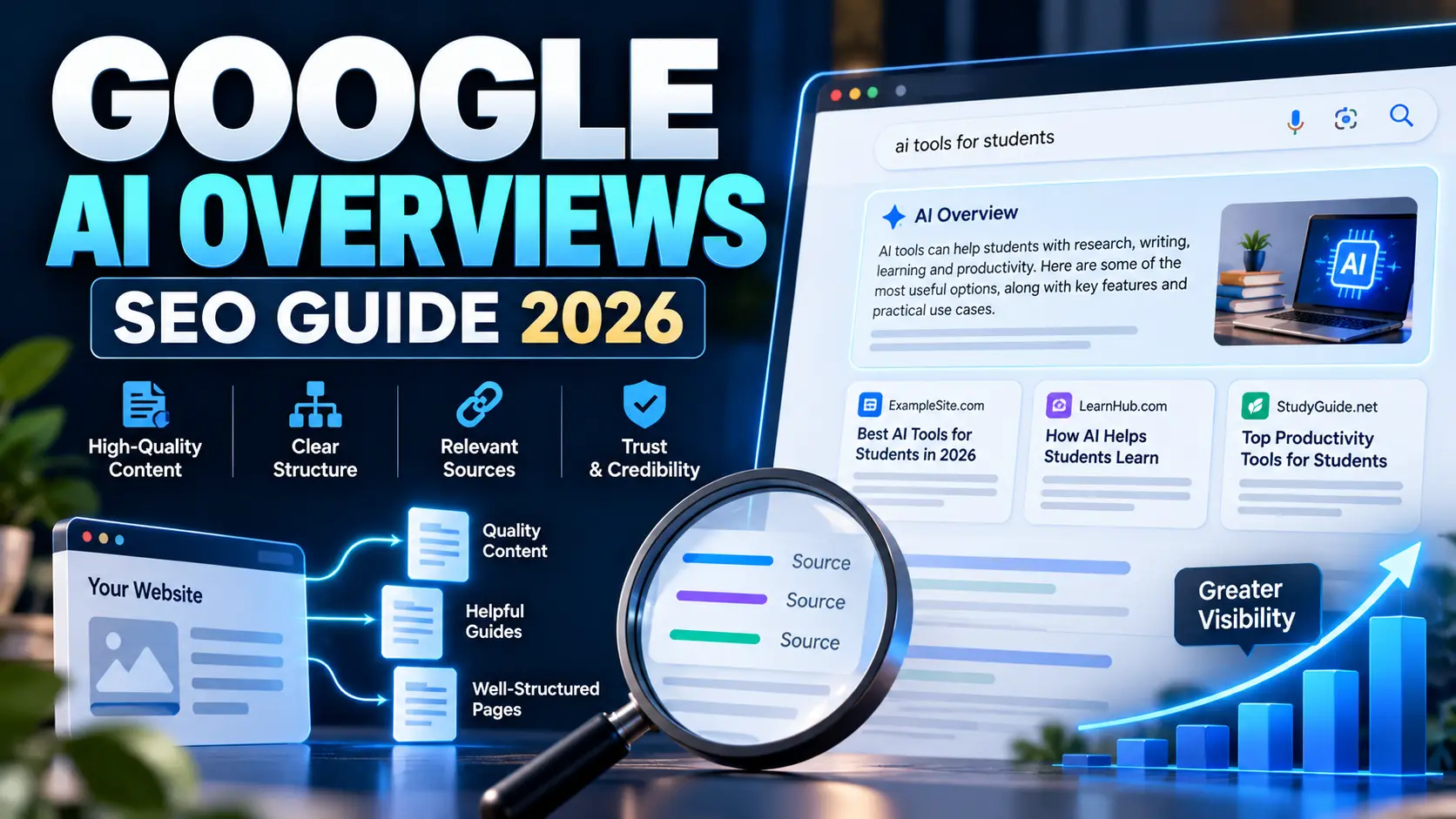
Google AI Overviews have changed how people discover information through Search. Instead of showing only a list of website links, Google can generate an answer to a question and display links to pages that support or expand on that answer.
For website owners, this creates an important question: What can you actually do to help your content appear in Google AI Overviews?
The answer is less complicated than some SEO marketing claims suggest.
Google says there is no special markup, secret keyword formula or AI-specific file that guarantees inclusion. Websites still need strong technical SEO, helpful original content, accessible pages and a good user experience.
In 2026, Google also introduced new Search Console reporting and controls that give site owners more visibility into how their content participates in generative AI search.
This guide explains what Google officially recommends, how AI Overviews select supporting information, which technical issues to check, and how to measure progress without relying on unsupported SEO tricks.
What Are Google AI Overviews?
Google AI Overviews are AI-generated summaries that appear for certain searches when Google’s systems determine that a generated response can help users understand a topic.
An Overview may combine information relevant to different parts of a question and show links to supporting websites.
For example, someone searching for “how to choose an AI video generator for educational content” might want to understand features, licensing, production costs and workflow limitations.
Instead of treating each part as an unrelated search, an AI response can address multiple aspects of the question and provide sources that allow the reader to explore further.
AI Overviews and traditional Google results
Traditional search results generally display individual pages with titles, descriptions and links.
An AI Overview presents a generated explanation alongside supporting sources. Ordinary search results can still appear on the same results page.
Importantly, appearing as a supporting link is not identical to holding a particular position in traditional organic rankings.
A page might be relevant to one part of an AI-generated answer without appearing as the first conventional result for the original query.
Google does not publish a fixed formula for choosing which websites to cite.
AI Overviews are different from AI Mode
AI Overviews generally provide generated summaries within a broader Google Search results experience.
By contrast, AI Mode supports more exploratory interactions, including complex questions and follow-up searches.
The two features can use different techniques and may surface different sources for similar subjects.
For website owners, Google’s foundational SEO recommendations apply to both. However, one appearance in an Overview does not establish that a website will be shown consistently in AI Mode.
How Does Google Find Sources for AI Overviews?
Google describes its generative search features as building on existing Search ranking and quality systems.
One method is retrieval-augmented generation, commonly called RAG. In simple terms, the system retrieves relevant information from searchable sources to help ground an AI-generated response.
Google’s 2026 guidance also discusses query fan-out, in which its systems search related aspects of a complex request to gather useful information.
Consider a user asking:
“What should a small business check before using an AI voice cloning tool for customer support?”
Different aspects of the question may involve privacy, voice-owner consent, software capabilities, telephone regulations and human escalation.
A page explaining a particular aspect well could be useful even if it does not repeat the original search query word for word.
That is why covering real reader questions thoroughly matters more than inserting dozens of small keyword variations into an article.
Google’s official guide to optimizing for generative AI features in Search emphasizes useful, original content and established SEO practices rather than a separate ranking formula for AI.
Can Any Website Appear in Google AI Overviews?
A website does not need to be a major publisher simply to meet Google’s technical eligibility requirements.
However, eligibility and actual selection are different things.
Google says a page generally needs to be:
- Indexed in Google Search.
- Eligible to appear in Search with a snippet.
- Accessible under relevant crawling and indexing requirements.
- Compliant with Google’s applicable Search policies.
- Part of a site that Google includes in its Search generative AI features.
Meeting these conditions does not guarantee that Google will display the page in an AI Overview.
Check the Search Console inclusion control
One significant change in 2026 was Google’s introduction of a dedicated Search generative AI control in Search Console.
Google says it completed the global rollout of this control by August 31, 2026.
Property owners can manage whether Google includes their website’s links and content in supported generative AI features, including AI Overviews, AI Mode and generative AI features in Discover.
For most properties, inclusion is the default. Some properties inherit a setting from a parent property.
To review the current setting:
- Open Google Search Console.
- Select the correct website property.
- Go to Settings → Search generative AI.
- Review whether Google includes or excludes the property or applies a parent property’s preference.
If you exclude the property, Google will not show its content in the covered generative AI experiences while that setting applies.
This setting is separate from normal organic ranking controls. Website owners should understand the implications before changing it.
What Actually Helps a Website Become a Useful Source?
Good source verification begins before a page is published. Our AI powered research assistant guide walks through evidence tables, checking citations and resolving conflicts between sources—steps that improve editorial reliability without promising AI Overview inclusion.
There is no single optimization trick, but several actions can make a website more useful and technically accessible.
1. Publish information that adds something original
Google’s May 2026 guidance stresses the value of unique, non-commodity content.
A generic article repeating information already available on hundreds of websites may give readers little reason to visit.
Original value can come from firsthand demonstrations, careful comparisons, documented examples, practical calculations, expert explanations or detailed analysis of a specific problem.
For instance, an article titled “Benefits of AI Tools” might list familiar advantages such as saving time and increasing productivity.
A more helpful article could explain the actual costs of generating a five-minute AI video, why failed renders increase expenses, and how to estimate a project’s budget.
That is a narrower problem with a more practical answer.
Our ChatGPT Search vs Google guide compares conversational search answers with conventional results and explains why source evidence and click-through behavior still matter to content creators.
Originality does not require access to proprietary research. It does require adding meaningful insight rather than recycling generic descriptions.
2. Answer the reader’s question directly
A useful page should not make visitors scroll through several vague paragraphs before receiving the information they searched for.
If an article covers copyright for AI-generated images, explain the basic rule early and then explore the important exceptions.
A direct answer helps the reader establish context.
The rest of the article can provide definitions, real examples, limitations and practical instructions.
This is an editorial recommendation, not a claim that placing an answer in the first paragraph guarantees an AI citation.
3. Organize information around genuine subtopics
Clear headings help visitors navigate an article, particularly when the subject involves several related questions.
A good structure follows the reader’s learning process.
For example, a guide to AI-generated image copyright might explain:
- What U.S. copyright law requires.
- How human creative work changes the analysis.
- The difference between copyright and commercial licensing.
- What to consider before publishing or selling the artwork.
Each section should add information rather than restating the same answer in different words.
Avoid splitting every sentence into a separate heading merely because an SEO tool recommends more keywords.
Google’s systems can understand relevant information without requiring artificial content chunking.
4. Show why important claims can be trusted
Help readers distinguish verified information from speculation, product marketing and personal interpretation.
For time-sensitive topics, consult official documentation before publishing statements about prices, policies, product limits or eligibility.
A guide covering an AI service should clearly identify which information comes from the provider and which conclusions are the writer’s own analysis.
If you have not tested the product, do not imply firsthand testing.
For example, our AI voice cloning consent guide addresses permissions and risks using an informational approach instead of treating a vendor’s marketing claims as independent proof.
This kind of clarity makes content more trustworthy to human readers. Do not present this as an automatic ranking signal or citation guarantee.
Technical SEO Still Matters in 2026
Even excellent content can struggle to appear in Search if Google’s systems cannot access or properly index the page.
A technically sound website is the foundation of discoverability.
Make sure Google can crawl important pages
Check that relevant pages are not blocked accidentally by robots.txt, security settings, hosting rules or a content delivery network.
Some websites allow normal visitors to load a page while unintentionally restricting Googlebot.
The problem can be especially confusing when a page appears correctly in a browser but has limited visibility in Search Console.
Before editing crawling rules, diagnose the specific URL and determine whether the restriction is intentional.
Check indexing and snippet eligibility
Google says supporting links in AI Overviews and AI Mode must meet the requirements for indexing and showing snippets.
Use Search Console’s URL Inspection tool to review the page’s known indexing state and Google’s selected canonical when available.
Also examine whether the page uses restrictive directives such as:
noindex, which prevents indexing.nosnippet, which prevents a text snippet from being displayed.- Other snippet controls that limit how content may be previewed.
These directives serve legitimate purposes. Do not remove them automatically without first understanding why someone added them.
Remember that indexing eligibility does not guarantee a place in Search results.
Use clean canonical URLs
A canonical URL helps Google understand which version of similar content should be treated as the preferred page.
Problems can arise when multiple URLs contain nearly identical content or when a canonical points to the wrong page.
When a guide belongs on the main .com domain, its canonical should not point to an unrelated review on another domain.
AIReviewDock’s .com and .online websites have separate editorial purposes. Their content and canonical structures should remain independent.
Do not duplicate entire articles across those sites to target the same keyword.
Use helpful internal links
Internal linking helps readers discover related content and helps search engines find important pages.
A useful internal link connects two pages because one genuinely adds context to the other.
For example, a general article about AI search can mention content production, but a detailed guide should address a specific subject deeply enough to deserve its own page.
Links should use meaningful anchor text rather than generic phrases such as “click here.”
Not every article needs exactly seven links. The right number depends on how many genuinely relevant published pages exist.
Make important content available as readable text
Google recommends making essential information accessible in text form.
If the central explanation exists only inside an image, video or complex interactive feature, readers and search systems may have difficulty accessing it.
Images and videos can make a guide easier to understand, but they should support—not replace—the important explanation.
Use readable headings, descriptive image alt text and sensible page layouts.
Provide a good mobile experience
A visitor reaching a guide through Google Search should be able to read it comfortably.
Check whether the page loads reasonably, images fit their containers, navigation works and important text remains legible on mobile devices.
Page experience is not a shortcut to AI Overview inclusion, but poor usability can weaken the value of traffic the site receives.
Does E-E-A-T Help With Google AI Overviews?
E-E-A-T refers to experience, expertise, authoritativeness and trustworthiness.
Google uses these concepts in its guidance for assessing content quality, but E-E-A-T is not a single numeric ranking factor that a website can increase by adding a badge.
The practical lesson is to communicate expertise honestly.
An author with firsthand software experience can provide actual examples and describe the testing process.
Documentation-based editorial guides can identify relevant official sources without claiming firsthand testing.
A site publishing business or legal information should acknowledge significant limitations and avoid offering unsupported guarantees.
Why transparency matters for AI content
Google does not treat every use of AI writing assistance as spam.
The concern is whether the resulting content is accurate, useful and created primarily to help visitors, rather than generating large numbers of low-value pages to manipulate rankings.
AI-generated drafts can support an editorial workflow. They still need factual checks, meaningful editing and accurate presentation.
A trustworthy website should never invent authors, reviews, traffic figures or experiments to create the appearance of expertise.
Are Schema Markup and FAQ Sections Required?
Google does not require special structured data specifically for AI Overviews.
Likewise, websites do not need new machine-readable files, AI-specific markup or a dedicated schema type to appear in Google’s generative search features.
That does not make ordinary structured data useless.
Appropriate Article, Organization, Breadcrumb or other supported schema can still help Google’s broader understanding of a website and its eligibility for relevant Search features.
The important rule is that structured data should accurately match the visible content.
What about FAQ schema?
Adding an FAQ section can be useful when readers have distinct, unanswered questions.
But adding FAQ markup does not guarantee that AI Overviews will cite a page or give it a special search appearance.
A well-written FAQ should resolve genuine issues, not reproduce the main article in question-and-answer form.
Does an llms.txt file improve Google AI visibility?
Google’s 2026 guidance says its Search systems do not require or use llms.txt as a special signal for generative AI visibility.
Some other services may use similar files for different purposes, but creating one is not a Google AI Overviews optimization requirement.
For Google Search, prioritize accessible HTML, useful content, technical health and appropriate site structure.
How to Choose Topics Without Chasing AI SEO Myths
The best topic often starts with a specific reader problem rather than a broad keyword.
Consider the difference between these two ideas:
Broad topic: Best AI software.
Specific topic: How to estimate AI video generation costs when rendering credits are limited.
The specific question offers room to explain a workflow, identify trade-offs and provide meaningful examples.
It is also easier to define what a useful answer should contain.
Research search intent before writing
Search the likely query and examine the kinds of pages Google already presents.
Look for whether readers want a definition, step-by-step instructions, current policy information, a comparison or a purchase decision.
A detailed informational article does not need to become a product review simply because competing pages include affiliate buttons.
Search intent should determine the content format.
Avoid publishing every possible keyword variation
Creating separate articles for nearly identical phrases can result in overlapping pages that offer little additional value.
Google’s 2026 guidance warns against scaled content made primarily to manipulate Search, including generative AI experiences.
Instead, give each page a clear purpose.
If one substantial guide can answer several closely related questions well, a collection of slightly rewritten articles may be unnecessary.
Keep SEO metrics grounded in actual data
Keyword volume, competition scores and traffic estimates can help with planning when reliable data is available.
Treat those metrics as third-party estimates, not Google guarantees.
If Ahrefs, Semrush or another tool is unavailable, do not manufacture volume or difficulty figures.
Search Console data, actual audience needs and realistic editorial opportunities are more useful than invented numbers.
How to Measure AI Overview Visibility in Search Console
One of the most important developments in 2026 was the introduction of dedicated generative AI performance reporting.
Google announced the new reports on June 3, 2026, and says the rollout reached websites worldwide by August 31, 2026.
The reporting helps site owners understand visibility within generative AI experiences across Search and Discover.
What the reports can show
Google describes information such as:
- Impressions associated with generative AI features.
- Pages that appeared in those experiences.
- Countries where visibility occurred.
- Devices used by searchers, where supported.
- Changes over time.
These reports complement normal Search performance analysis.
Do not interpret them as a window into Google’s internal citation-selection algorithm.
An impression is also not automatically a website visit, sale or conversion.
How to review your website’s data
Open the appropriate property in Google Search Console and locate the available generative AI performance report.
Review which pages have impressions, then examine their content and search intent.
For example, a guide explaining a specific AI policy might receive visibility for complex informational queries even if another page generates more ordinary Search impressions.
Look for patterns across several pages rather than judging the website by one search result observed on one device.
Compare AI visibility with actual business outcomes
Website owners should continue measuring ordinary search traffic, engaged visits and other meaningful outcomes.
For a commercial website, a visit that leads to a useful action can matter more than a large impression count without engagement.
Avoid claiming that an AI Overview citation automatically produces qualified traffic or higher conversions.
The new reports help describe visibility; they do not replace business analytics.
A Practical Google AI Overviews SEO Workflow
Here is a realistic process for improving an existing informational article.
Step 1: Confirm that the page is useful
Read the article as a visitor.
Does it answer the main question? Are important exceptions explained? Does it offer something more helpful than a generic summary?
Identify missing examples or outdated information before changing metadata.
Step 2: Verify important claims
Check official documentation for policies, feature availability, pricing and technical requirements.
Separate facts from interpretation.
Where the information is uncertain, say so rather than presenting guesses as established rules.
Step 3: Improve the page’s organization
Use a clear title, descriptive section headings and a logical sequence of explanations.
Add a table, example or checklist when it genuinely makes a complicated subject easier to understand.
Do not add headings purely to repeat keywords.
Step 4: Review technical eligibility
Confirm that the page can be crawled, is eligible for indexing and snippets, and has an appropriate canonical URL.
Check the Search Console generative AI inclusion setting for the property.
Do not make unnecessary changes to global robots or indexing settings without diagnosing a specific issue.
Step 5: Improve supporting media and links
Use a relevant featured image and descriptive alt text.
Link to genuinely related published articles and appropriate official sources.
Avoid unrelated product links or promotional buttons in informational guides.
Step 6: Review on mobile
Inspect the final page layout and ensure text remains readable, tables fit properly and links are usable.
Check that important explanations are visible without requiring complex interactions.
Step 7: Measure after publication
Use Search Console to monitor indexing, conventional Search performance and generative AI visibility.
Document substantive editorial improvements and compare performance over a reasonable period.
Do not expect immediate citation changes after every update.
Common Google AI Overviews SEO Mistakes
The first mistake is believing that a special AI optimization plugin guarantees citations. Google’s own documentation does not support that promise.
Another is writing articles only for AI extraction, with repetitive definitions, artificial headings and little value for readers.
A third is copying competing articles without adding original explanation or evidence.
Technical mistakes also matter. A valuable article may be inaccessible to Googlebot, blocked from indexing or excluded from snippet eligibility.
Finally, measuring success only by whether one manually tested query displays a website link creates an incomplete picture. Search results vary, and the same site may appear for related questions rather than the exact phrase you’re monitoring.
Google applies different rules to some audiences. Our breakdown of the new opt-in rules for AI Search in schools explains who they affect.
Frequently Asked Questions
Does Google require special AI Overview schema?
No. Google says there is no special schema.org markup or AI-specific structured data requirement for inclusion. Ordinary valid structured data can still serve broader SEO purposes.
Can a small website appear in AI Overviews?
A smaller website can meet the eligibility requirements, but Google does not promise citations to websites of any size. Original information, technical accessibility and relevance remain important considerations.
Must an article rank number one to be cited?
Google does not publish a rule requiring a particular traditional ranking position. AI-generated answers can involve different supporting pages and related queries. No ranking position guarantees inclusion.
Is AI-written content banned from Google AI Overviews?
Google’s policies do not categorically ban content merely because AI assisted with writing. Low-value, inaccurate or scaled content created to manipulate rankings can violate Search policies.
Will adding more FAQs help my page get cited?
Not automatically. FAQs can improve an article when they answer genuine remaining questions, but unnecessary repetition or markup does not create a citation guarantee.
Can I disable my website’s inclusion in AI Overviews?
Yes. Google’s 2026 Search generative AI control allows eligible property owners to manage inclusion in the covered AI features. Review how inherited property settings work before changing anything.
How quickly will Google show an improved page?
There is no fixed timeline. Google must discover and process changes, and indexing or inclusion is never guaranteed. Search Console can help diagnose technical issues and monitor performance over time.
Final Thoughts
Google AI Overviews SEO in 2026 is not about discovering a secret markup tag or rewriting every sentence for artificial-intelligence systems.
The strongest approach remains to create genuinely useful material, make it accessible to Google Search, organize it clearly, support important claims and provide a satisfying experience for readers.
Google’s 2026 additions to Search Console make it more practical to check inclusion settings and measure generative AI visibility. They do not create a guaranteed path to citations.
Website owners should build pages worth visiting—not merely pages written for machine-generated summaries.
Make the content original, keep the technical foundation sound, and use verified performance data to guide improvements.