
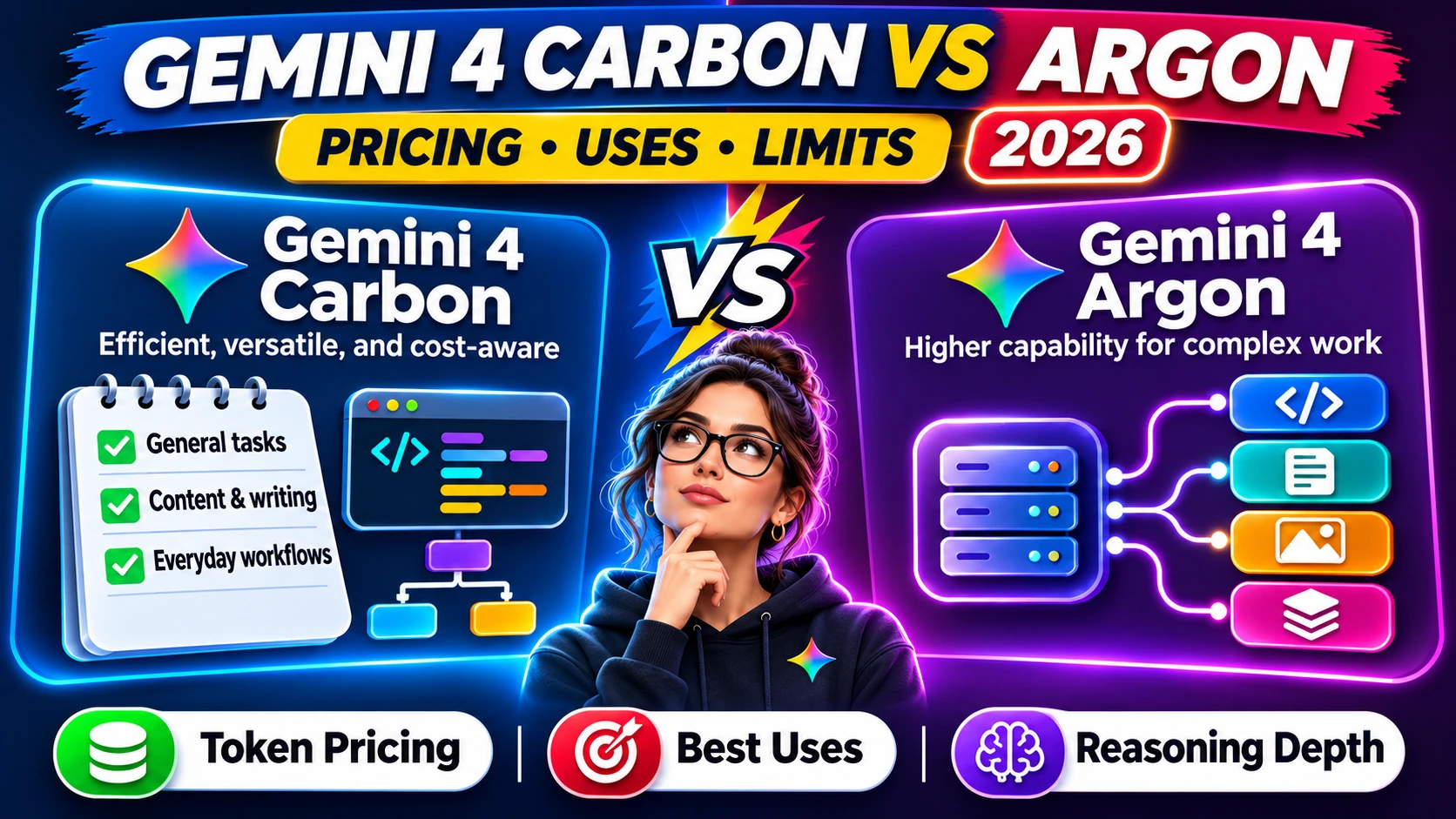
Gemini 4 Carbon vs Argon (2026): Google launched Argon for advanced professional reasoning and made Carbon available in November for even harder long-horizon tasks. Both carry the same published introductory API token rates, but Carbon may use more tokens. This comparison explains capabilities, the announced November 30 pricing change, illustrative cost calculations, access options and a seven-step evaluation plan.
Updated November 21, 2026. Confirm live prices and model availability with Google before committing to an integration.
Gemini 4 Carbon vs Argon: the short answer
Gemini 4 Carbon vs Argon is Google’s newest model-choice question in November 2026. Argon is positioned for demanding but broadly useful coding and knowledge work. Carbon is positioned for problems that need deeper, longer reasoning, including difficult engineering investigations, advanced cybersecurity defense and research. Google says Carbon can use more tokens to explore and verify a solution. That distinction matters to your bill as well as your output.
Carbon became broadly available for paying developers and enterprises on November 10, 2026. In its announcement, Google described Argon as suitable for the majority of software engineering and knowledge work, and Carbon as the option for tasks testing the limits of the model’s intelligence. These are vendor descriptions; this article does not pretend that AI Review Dock independently benchmarked both APIs.
For most teams, the cost-effective default is to start with Argon on ordinary work and measure whether Carbon provides enough improvement for the hardest tasks. The pricing headline alone is misleading because two models with the same per-token rate can create different bills if one uses more output tokens or repeated reasoning steps.
Gemini 4 Carbon vs Argon comparison table
This reference summarizes publicly described positioning as of November 21, 2026. Product availability, model details and caps can change, so confirm the exact plan in your Google account. Do not assume all users can choose both models with the same limits.
| Factor | Gemini 4 Argon | Gemini 4 Carbon |
|---|---|---|
| Main positioning | Advanced reasoning for broad knowledge work and software engineering | Hardest long-horizon problems and deeper verification |
| Example tasks | Code review, complex reports, document synthesis | Multi-step debugging, difficult investigations, open research |
| Reasoning behavior | Designed for long workflows | May use additional tokens and verification loops |
| Developer availability | Google AI Studio paid-tier API | Google AI Studio API for paying developers |
| Introductory API input | $2 per million tokens | $2 per million tokens |
| Introductory API output | $10 per million tokens | $10 per million tokens |
| Published post-intro input* | $4 per million tokens | $4 per million tokens |
| Published post-intro output* | $20 per million tokens | $20 per million tokens |
*Google’s published pricing notices state that the introductory period ends November 30, 2026. Check live pricing before building a budget; the table reflects the notices available when this article was prepared. Subscription access and third-party charges are separate from API prices.
For the original descriptions, consult Google’s Carbon availability announcement and Argon announcement.
Gemini 4 pricing: what changes after November 30, 2026?
The most actionable part of this comparison is the approaching price transition. Google’s notices describe introductory API pricing of $2 per million input tokens and $10 per million output tokens for Argon and Carbon, and list $4 and $20 respectively after the introductory period expires on November 30, 2026. That would double the listed per-token rates compared with the launch promotion. Always check the provider’s live billing page before relying on a historic article.
Here is a transparent illustrative calculation. Suppose an application sends 1.5 million input tokens and receives 300,000 output tokens during a billing period. At $2 input and $10 output, the token subtotal is $3 + $3 = $6. At $4 input and $20 output, it becomes $6 + $6 = $12. This is an arithmetic example, not a quote from a specific customer invoice. Caching, other metered features, taxes and tier conditions may change a real bill.
Now suppose the same task generates 600,000 output tokens because a harder problem leads to more exploration. Keeping input volume at 1.5 million, the introductory subtotal becomes $3 + $6 = $9, and the post-intro example becomes $6 + $12 = $18. This does not prove that Carbon always uses twice as many output tokens. It demonstrates why measuring actual token usage matters more than comparing headline rates.
| Illustrative workload | Introductory rates | Published post-intro rates |
|---|---|---|
| 1.5M input + 0.3M output | $6 | $12 |
| 1.5M input + 0.6M output | $9 | $18 |
| 3M input + 1M output | $16 | $32 |
For context about token accounting, cached prompts and avoiding surprise costs, read our AI API pricing guide. The table there is about general cost mechanics; the examples here use the published Gemini 4 pricing notices.
When should developers choose Argon?
Start with Argon when a task needs serious reasoning but can be completed with a clear prompt, limited verification and a predictable output. Examples include reviewing a code module for maintainability, drafting a detailed technical memo, organizing a research bibliography, interpreting internal documents under human supervision or producing a structured implementation plan.
Google’s Argon release emphasizes real-world engineering, enterprise knowledge work and cybersecurity defense. This is not a guarantee that every task will be accurate. Developers should still run tests, review citations and confirm potentially sensitive conclusions. For software changes, rely on a repository test suite, independent code review and staged deployment rather than a model’s confident wording.
A practical evaluation asks: does Argon reach an acceptable result on a representative test set, and can it do so within your time and cost budget? If the answer is yes, keep the workflow simple. Using a more demanding model by default can increase compute and operational complexity without delivering proportionate value.
For a service desk, the evaluation might include summarizing 50 synthetic tickets with known categories, identifying the correct policy document and writing a draft reply. A human reviewer would compare factual accuracy and output clarity. The model should never invent customer account information or make an unapproved change.
When should developers choose Carbon?
Carbon is positioned for the toughest problems: long chains of reasoning, complex multistep debugging, more open-ended scientific work and demanding security analysis. Google highlights additional verification and more thorough exploration. Those features can be valuable when a difficult problem cannot be resolved reliably by a simpler workflow.
Imagine an engineering team investigating an intermittent failure across several interacting services. The question is not merely ‘explain this error message’ but ‘form competing hypotheses, inspect evidence, identify missing logs and propose safe tests.’ A deeper model may help structure the investigation. The team still decides which tests are authorized and whether the proposed fix is safe.
In research, Carbon may help map hypotheses, compare limitations and find potential contradictions in documents. However, models can still generate unsupported claims. For high-stakes topics, experts must verify results against primary sources and the actual experiment or dataset. The more complex the task, the more important independent evaluation becomes.
If Carbon is part of an automated agent, permissions should remain bounded by the host application. A model’s reasoning strength does not justify giving it unfettered production access, secrets or the ability to deploy without review. Review our coding agents safety guide before enabling tools that can change repositories or live systems.
A fair benchmark: test the same work, not random demos
One way to choose between Argon and Carbon is to prepare a small, realistic test suite. Do not pick only cases that make one model look strong. Include tasks the team performs every week and a few difficult cases that caused past problems. Remove personal data and use authorized environments.
- Define success: write down what an acceptable answer must contain and which errors are unacceptable.
- Create the same inputs: use equivalent prompts, data and available context for both models.
- Repeat tests: run each task more than once where feasible because output can vary.
- Measure usability: record time to a correct final answer, manual corrections and retries.
- Record total usage: include input/output tokens and any additional billed features.
- Run safety checks: test how the workflow handles uncertain evidence, missing data and disallowed requests.
- Choose by task: prefer the least complex solution that achieves required quality consistently.
A useful scorecard includes correctness, groundedness, repeatability, latency, integration work, safety controls and total cost. Weight them according to the task. A scientific-research team might value depth and transparent uncertainty; a support workflow might prioritize predictable factual responses and cost. This article does not publish invented benchmark percentages.
If a vendor advertises a model comparison, ask whether the test includes hidden retries or longer reasoning budgets for one model. Compare outcomes and resources together. A model can produce a better answer while being less economical for routine tasks.
Model availability: Gemini app, AI Studio and subscriptions
There are different routes to Google’s models. A consumer subscription, an enterprise workspace and API billing are separate products with different terms. According to Google’s November Carbon announcement, paying developers can access Carbon through the API, while Google AI Ultra subscribers can try Carbon in the Gemini app and AI Mode in Search. Access in a particular region or account may still be subject to product availability and usage limits.
Do not calculate API costs from a consumer subscription fee. Similarly, having access in the Gemini app does not automatically mean a developer has the same usage allowance through an API key. Review the official plan page in the relevant product before building a service.
If you are already using Argon in a production integration, make a controlled upgrade plan. Save baseline tests, check model IDs and supported capabilities, then run side-by-side comparisons with synthetic cases. A model swap can change formatting, tool behavior, output length and cost even when the API interface looks familiar.
Our separate Gemini 4 Carbon pricing guide and Gemini 4 Hydrogen guide cover product-specific details. This page focuses on choosing between Argon and Carbon.
Five implementation mistakes that inflate costs
Sending all history every time. Large repeated context increases input usage. Summarize or retrieve the necessary records, and use supported caching appropriately. Do not delete information that is essential to a safe answer merely to lower token counts.
Choosing Carbon for every trivial task. Route routine formatting, tagging or short summaries to a sufficient lower-cost process when possible. Reserve more intensive reasoning for problems where it changes the decision.
Ignoring output size. Long exploratory answers can be useful, but unnecessary verbosity may add cost. State the required output format and preferred length. When a task needs a detailed report, measure its true value rather than forcing an arbitrary tiny answer.
Retrying failures without diagnosis. Repeated generations can multiply cost. Record the original failure, identify whether it came from missing data, tool permissions, prompt ambiguity or model behavior, and change one variable deliberately.
Deploying without validation. A model that performs well on a demo may fail on real inputs. Use staged releases and monitor quality, error rates, latency and token consumption. Ask a person to approve consequential operations.
These controls are useful regardless of which model you select. Model pricing is only one part of the economics of reliable AI software.
Frequently asked questions about Gemini 4 Carbon vs Argon
Is Carbon always better than Argon?
No single model is automatically the best value for every task. Google positions Carbon for especially difficult problems and Argon for broad professional use. Test your own use cases and compare output quality with total cost.
Do Argon and Carbon cost the same?
Google’s November 2026 notices list the same introductory per-token rates for both. However, token consumption may differ between workflows and the promotional period has a stated end date. Verify current official pricing.
What happens on November 30, 2026?
Google’s published notices say the introductory period ends then and list higher per-token rates afterward. Product conditions can change, so check billing documents before relying on the numbers.
Can I use Carbon in the Gemini app?
Google announced availability for eligible Google AI Ultra subscribers. Availability and quotas may vary by account, product and region.
Which is better for coding?
Argon is intended for complex engineering tasks and often makes a sensible default. Carbon is positioned for difficult multistep debugging and extended reasoning. Use actual test suites, human review and cost measurements.
Should I switch every Argon workflow to Carbon?
No. Compare a representative sample, confirm model compatibility and estimate total spend. A controlled pilot can reveal whether an upgrade provides enough value.
Final verdict: choose a model for the difficulty, not the label
The most practical Gemini 4 Carbon vs Argon decision is to use Argon as a baseline for demanding everyday tasks and trial Carbon where extended reasoning or verification may improve a difficult result. Measure actual token use and human correction time. Keep official pricing and product eligibility under review, especially around the announced November 30, 2026 transition.
Both models still require human responsibility for facts, security and business decisions. Google release notes are useful primary sources, but their benchmark descriptions are vendor claims. An independent application should evaluate the models against tasks that matter to its users.
Editorial note: Prepared November 21, 2026 from public Google announcements. Pricing is an announced schedule, not a guaranteed future bill. AI Review Dock has not claimed to run a private Argon/Carbon benchmark.