
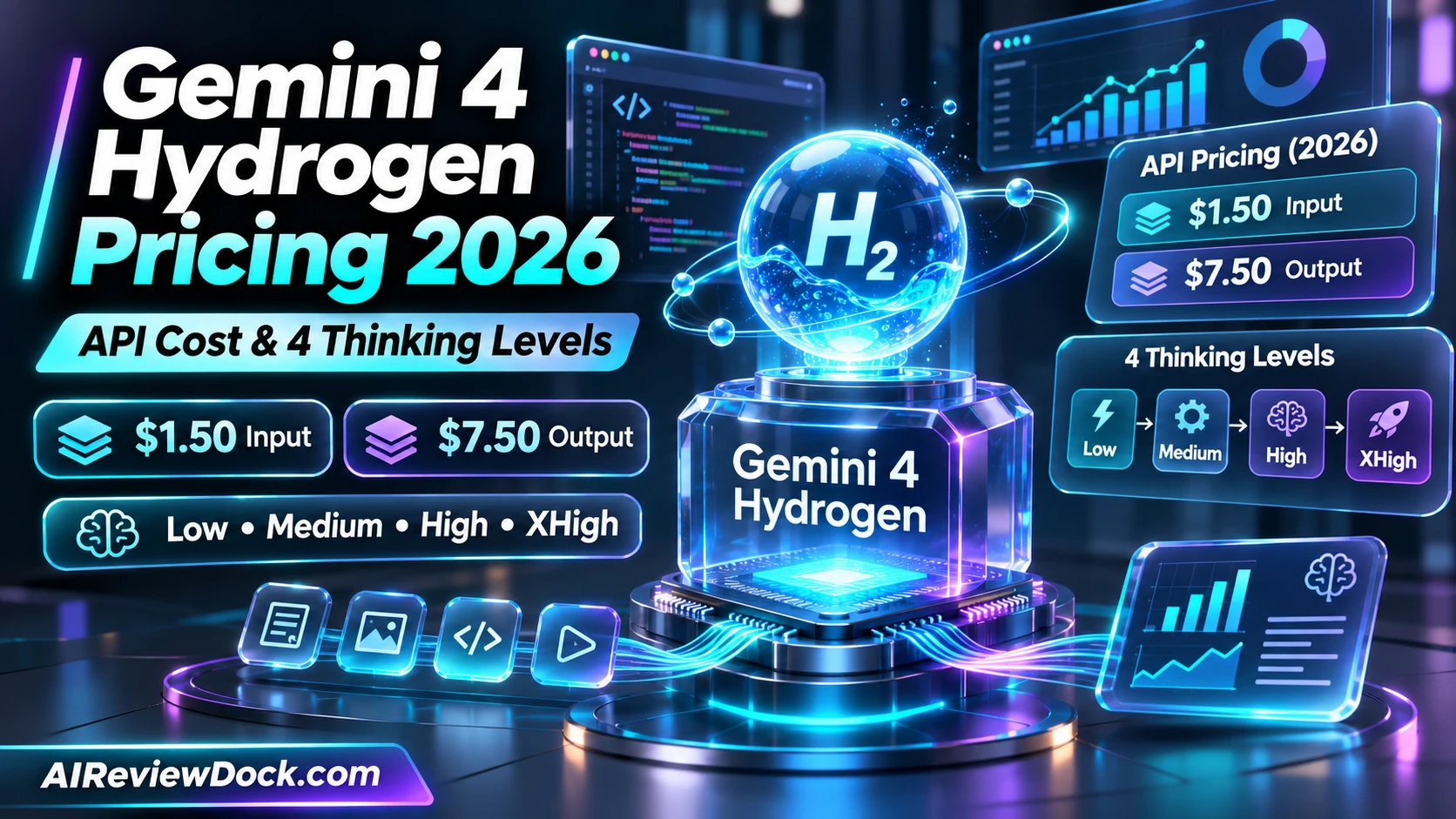
Gemini 4 Hydrogen pricing — Gemini 4 Hydrogen pricing begins at $1.50 per million input tokens and $7.50 per million output tokens for its standard developer API pricing. Google announced the model on November 12, 2026, positioning it as a fast everyday execution model alongside higher-reasoning Carbon and Argon. Hydrogen supports a million-token context and four selectable thinking levels, but API token costs and consumer subscription access are separate questions. This guide calculates example bills, explains who gets access, and shows when a lower-price model is not necessarily the cheaper workflow.
Updated November 14, 2026. We wrote this guide using official launch information and our own calculations. We have not tested the new model or API with a paid account, so we clearly label vendor claims and access limits. Prices are subject to change.
Gemini 4 Hydrogen pricing: quick answer and key facts
| Topic | Details |
|---|---|
| Announcement | November 12, 2026, Google DeepMind |
| Standard input | $1.50 per one million tokens |
| Standard output | $7.50 per one million tokens |
| Context | Up to one million input tokens |
| Thinking settings | Low, medium, high (default), xhigh |
| Google AI Studio | Available across developer tiers; applicable quotas differ |
| Consumer app | Free access through automatic model selection where appropriate |
| Antigravity | Availability and quotas depend on plan; verify model selector |
What is Gemini 4 Hydrogen and who needs it?
First, Gemini 4 Hydrogen pricing begins at $1.50 per million input tokens and $7.50 per million output tokens for its standard developer API pricing. Google announced the model on November 12, 2026, positioning it as a fast everyday execution model alongside higher-reasoning Carbon and Argon. Hydrogen supports a million-token context and four selectable thinking levels, but API token costs and consumer subscription access are separate questions. This guide calculates example bills, explains who gets access, and shows when a lower-price model is not necessarily the cheaper workflow.
Above all, the decision starts with one concrete task. A headline price or benchmark gives you a starting point. However, it cannot show whether your own requests work well, stay affordable or remain easy to maintain. Separate access through an app subscription from metered API access and inspect the vendor documentation for updates.
Seven capabilities of Gemini 4 Hydrogen, explained
1. Four thinking levels that change the workload
In particular, Hydrogen provides low, medium, high and xhigh thinking choices. Higher levels may spend more time or tokens on difficult tasks, while a simple classification or short rewrite can use a lower setting. Google publishes benchmark comparisons for its own evaluations, but you should test each level against real task speed and error rates. Do not select xhigh for every routine request without measuring the benefit.
2. Pricing is different from a subscription fee
By contrast, Google bills developers for API tokens. The Gemini app has its own free or paid consumer access and the Antigravity coding environment has separate plan quota rules. Paying for an AI Pro subscription does not automatically mean that the subscription covers every API call without token charges. Define which interface you are using before interpreting any price.
3. Large context, with real processing limits
For example, a one-million-token context means that long documents and substantial codebases can fit within a model request where supported. The model may still miss details or cite them incorrectly. Test retrieval accuracy on materials that exceed ordinary prompt lengths and budget for all input bytes converted into tokens.
4. Coding and agentic task execution
Additionally, Google describes Hydrogen as an execution engine for writing code, running tests, verifying changes and navigating repositories. Those examples are useful scenarios, not evidence of an independent production benchmark. When a coding agent operates on a live codebase, require clear file permissions, a test suite and rollback even if vendor evaluations describe better agent safety.
5. Multi-model orchestration with Carbon and Argon
Meanwhile, the Antigravity Orchestrator can route tasks to different Gemini models within a workflow. A deeper reasoning model may design an architecture while Hydrogen implements and validates smaller changes. Google reports efficiency gains in its internal benchmarking, but the quota impact will depend on the task mix and your subscription.
6. Availability in Search and the Gemini app
In addition, Google says Hydrogen is rolling out across Google Search, the Gemini app, AI Studio and enterprise experiences. Availability does not necessarily mean that every user can manually force the same model in every Google product. Free users may encounter it through automatic model selection while developer settings give more direct controls.
7. Vendor benchmarks need independent context
However, the launch announcement compares Hydrogen with Gemini 3.8 Flash and frontier models using multiple benchmark datasets. Scores describe specific test methods, and changes in system settings can affect results. A serious evaluation also needs real data privacy requirements, error tolerance, speed and total bill per successful deliverable.
Gemini 4 Hydrogen pricing: practical seven-step setup and testing guide
To begin, the steps below offer a repeatable way to test the product. We have not bought access or run our own benchmarks. Keep a baseline, record assumptions and use non-sensitive inputs until permissions and privacy terms are understood.
Step 1: Choose the interface before calculating
First, decide whether you need the consumer Gemini app, Google AI Studio, API integration, or Antigravity. Record the plan, region and any current quotas. The most relevant bill is the one attached to your specific access route.
Step 2: Create a small benchmark set
Next, collect ten representative tasks: a simple reply, a short document extraction, a difficult code change, a structured JSON classification, and several realistic follow-ups. Keep input files and success criteria fixed.
Step 3: Run a baseline at the default high setting
Then, record response accuracy, elapsed time, input tokens and output tokens. Repeat several times if the task has randomness; a single fast answer is not a stable comparison.
Step 4: Compare lower and xhigh settings
Afterward, check whether low or medium produces acceptable results for routine cases. Reserve xhigh for high-value cases where deeper analysis measurably improves correct outcomes.
Step 5: Calculate expected API spend
Next, multiply input tokens in millions by $1.50 and output tokens in millions by $7.50. Count any applicable tools, thinking tokens, retries and separate service fees reported by the provider.
Step 6: Compare with Carbon or Argon using the same workload
By comparison, run the same evaluation suite and compare cost per successful task, not only per-token price. Carbon’s introductory prices may change after November 30, 2026, so date the comparison.
Step 7: Set budget and monitoring controls
Finally, use restricted API keys, usage alerts and a safe fallback for rate limits. Never expose a production key in a blog post, browser script or public source repository.
Gemini 4 Hydrogen pricing: cost examples and limitations
For example, these numbers use public list prices. They show example costs, not charges from our own account. Taxes, regional differences, rate tiers, media processing, retries and downstream tools can alter a bill. Model output quality also affects the real cost of a completed job.
| Workload | Estimated amount | How to interpret it |
|---|---|---|
| 1M input + 1M output | $9.00 | 1 × $1.50 + 1 × $7.50 |
| 2M input + 1M output | $10.50 | 2 × $1.50 + 1 × $7.50 |
| 10M input + 2M output | $30.00 | 10 × $1.50 + 2 × $7.50 |
| 10M input + 2M output on Carbon (promo) | $40.00 | 10 × $2 + 2 × $10, through Nov 30 |
| Example savings for that workload | $10.00 | Not equal to a quality or accuracy comparison |
Where Gemini 4 Hydrogen fits in a real workflow
AI customer-support triage
For instance, Hydrogen could summarize a ticket and propose the next agent action, with a human-approved escalation for payments, legal commitments or safety issues. Measure whether lower thinking settings correctly recognize unusual cases.
Repository change review
Meanwhile, an engineer can give Hydrogen a bounded code task with unit tests. The job is complete only if tests pass, developers keep code changes within scope and reviewers understand them. Model speed is secondary to avoiding broken deployments.
Large report synthesis
Likewise, a team can compare a long financial or technical report with a list of source-backed questions. Check citations against the actual file and avoid treating the large context window as a guarantee of factual extraction.
Mistakes and safety checks before production
- Do not confuse consumer subscriptions, API billing and third-party platform quotas.
- Avoid trusting vendor benchmark numbers as an independent evaluation of your own workload.
- Use access-controlled API keys, least-privilege tool scopes and a way to revoke credentials.
- Keep a human approval step for irreversible, financial, security or high-stakes decisions.
- Track failed requests, retries and output quality rather than counting only successful API responses.
- Recheck pricing, eligibility and limits before moving from a prototype to a paid production workload.
Therefore, when testing a new feature, change one parameter at a time and preserve a rollback. Publishing a confident-looking result without reviewing the underlying inputs is a risk whether the model is inexpensive or state of the art.
Alternatives and related reading for Gemini 4 Hydrogen
For related AIReviewDock.com technical guides, read Gemini 4 Carbon pricing guide and AI API token and caching cost guide. These cover adjacent concepts without duplicating this new product announcement.
On the other hand, if you are evaluating commercial software rather than the underlying APIs, our separate AIReviewDock.online site has buyer-oriented articles such as NEURA AI review and SuperPlug AI review. Those are different products, not replacements for the feature explained here.
Gemini 4 Hydrogen pricing: frequently asked questions
What is the Gemini 4 Hydrogen API price?
In short, Google lists standard developer pricing at $1.50 per million input tokens and $7.50 per million output tokens. Confirm current billing rates before deployment.
Is Gemini 4 Hydrogen free to use?
However, Google has free access paths in its consumer products and AI Studio subject to quotas, but production API use and model access vary by tier.
Does Hydrogen replace Gemini 4 Carbon?
No. Google positions Hydrogen as a fast execution option while Carbon and Argon target more demanding long-horizon tasks.
What are the four thinking levels?
Low, medium, high by default and xhigh. Choose them based on measured latency, accuracy and output-token use.
Is the context window one million tokens?
Also, Google describes a native one-million-token input context. Verify implementation-specific limits and file support.
Do I need Google AI Pro for Hydrogen?
Not necessarily in the Gemini app. Antigravity and enterprise entitlements differ; verify your account rather than assuming identical benefits across products.
Can Hydrogen guarantee accurate code?
No. Use repository permissions, automated tests and independent review for generated code.
Verdict: is Gemini 4 Hydrogen worth trying?
Overall, Hydrogen is interesting for developers who want a faster execution model with a lower published API rate than the current Carbon promotional rate. It is not automatically the best choice for every complex task. Build a small task set, compare error rates and calculate cost per usable result before migrating a production application.
For this reason, before investing in a migration, keep a working baseline and check the current official documentation. An announcement can attract attention quickly. However, long-term value depends on the task, access, clear billing and results you can check.
Official sources and editorial method
Finally, first-party resources checked November 14, 2026: Google’s November 12 Gemini 4 Hydrogen announcement and official Gemini Developer API pricing reference. This guide includes original workflow suggestions and illustrative calculations, not a claimed independent benchmark.