
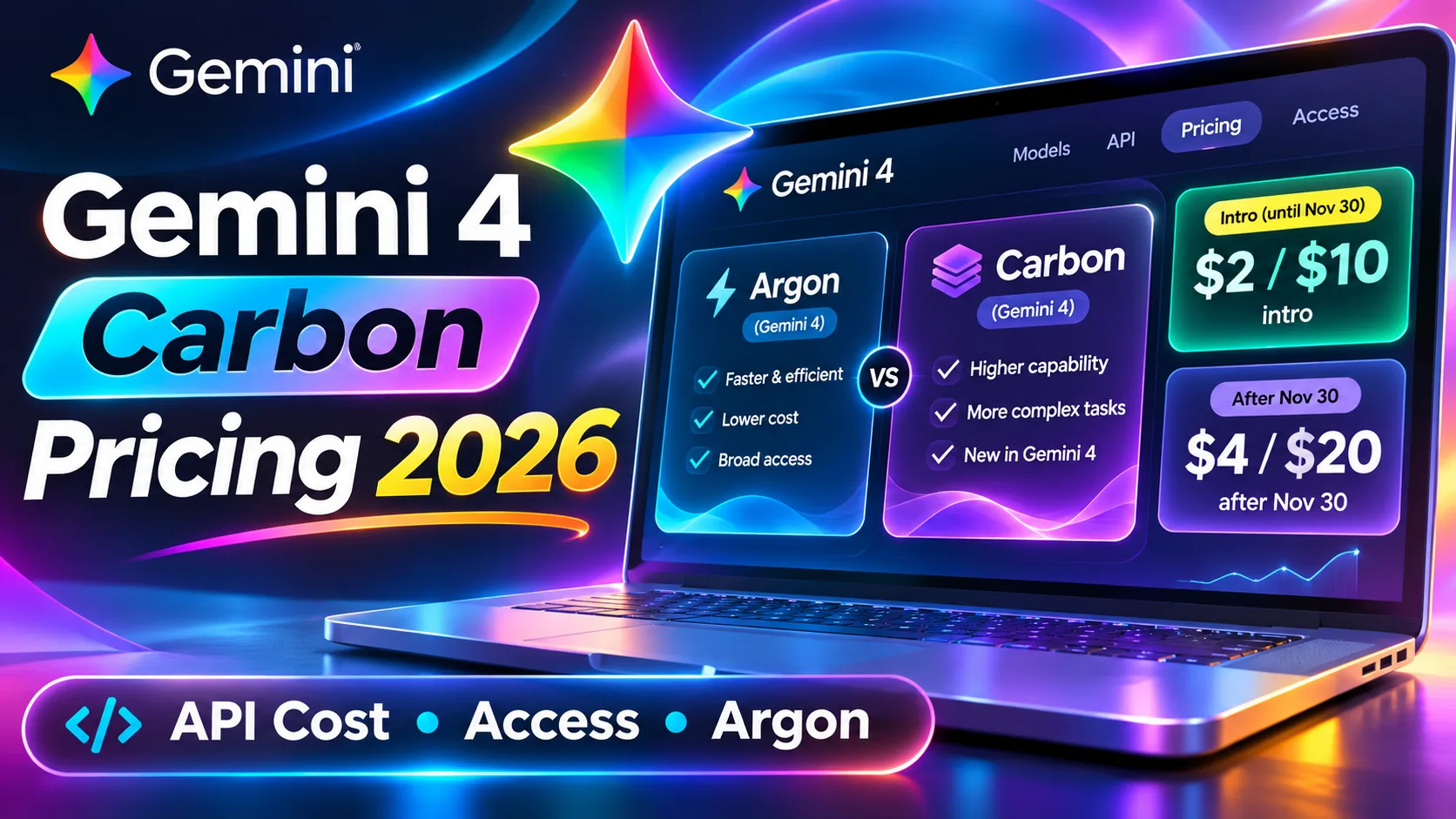
Gemini 4 Carbon pricing — Gemini 4 Carbon pricing changed the choice for developers on November 10, 2026, when Google expanded access to its frontier model. The introductory API rate is $2 per million input tokens and $10 per million output tokens, with a published increase after November 30. Consumers need a Google AI Ultra subscription for the newly announced app rollout. This guide separates API billing, consumer access and the practical differences between Carbon and Gemini 4 Argon.
Last fact-checked: November 10, 2026. This is a source-based educational explainer, not a paid performance benchmark or a promise of free access. Model prices and account availability may change. We separate official announcements from our practical recommendations.
Gemini 4 Carbon pricing: the essentials
- Google announced the broad Gemini 4 Carbon rollout on November 10, 2026; the earlier limited cyber-defender launch was October 28.
- Paying API customers can use Carbon in Google AI Studio; Google AI Ultra users receive access in supported consumer and developer surfaces.
- Introductory API rate: $2 input and $10 output per million tokens, increasing to $4 and $20 after November 30, 2026.
- Google positions Argon as the better default for many routine tasks and Carbon for harder long-horizon work requiring deeper checking.
- The Antigravity /swarm feature is a preview for coordinating multiple agents, not a guarantee that every account can use it.
Gemini 4 Carbon pricing: comparison at a glance
| Area | Gemini 4 Argon | Gemini 4 Carbon |
|---|---|---|
| Public model launch | October 2026 | October 28 limited; November 10 expanded |
| General role | Most coding and knowledge tasks | Hard multi-step problems, research and audits |
| Intro API input | $2 / 1M tokens | $2 / 1M tokens through Nov 30 |
| Intro API output | $10 / 1M tokens | $10 / 1M tokens through Nov 30 |
| After Nov 30 price | Check Argon live pricing | Carbon $4 input / $20 output per 1M |
| Consumer rollout | Access varies by current Google plan | Google AI Ultra announced |
| Workflow choice | Useful baseline model | Escalation when evaluations justify more reasoning |
What is Gemini 4 Carbon, and what changed today?
Google describes Carbon as its most capable model for technical problems that require several connected reasoning steps, complex debugging and research. The headline is not only a new benchmark result. It is that access expanded beyond the initial approved cybersecurity group to paying developers, enterprises and qualifying consumer subscribers.
Carbon is not the automatic best setting for every prompt. A product FAQ, spreadsheet cleanup or short email may work well with a less costly and faster option. On the other hand, a multi-repository migration, difficult scientific analysis or code-quality investigation may benefit from additional reasoning and verification loops.
Crucially, vendor-reported tests should not be treated as a guarantee for your own job. Compare the same task across models, inspect factual citations and measure the cost of acceptable output rather than choosing by a leaderboard rank alone.
Gemini 4 Carbon pricing in November 2026
Google lists an introductory Gemini 4 Carbon API price of $2 for one million input tokens and $10 for one million output tokens. This promotional period ends on November 30, 2026. After that date, the published Carbon rates become $4 input and $20 output per million tokens. Check current billing documentation before committing recurring budgets.
Here is a transparent calculation: 1,000,000 input tokens plus 100,000 output tokens would cost $2 + $1 = $3 at the introductory rates. At the stated later rates, the same token usage would cost $4 + $2 = $6. These are token-only examples, not total invoices including external tools or other service charges.
Because deep reasoning can produce more output tokens and more tool steps, price per token is not the same as price per successful project. If Carbon uses twice as many tokens but avoids several failed retries, it may still be economical. Conversely, if Argon already passes your test cases, the smarter choice may be to keep the simpler workflow.
Is Gemini 4 Carbon free, or do you need Google AI Ultra?
Google’s November 10 announcement specifies Carbon on the paid Gemini API tier through AI Studio and Android Studio. Google AI Ultra subscribers are also included in the rollout to Antigravity, the Gemini app and AI Mode in Search. That is not a blanket announcement of unlimited free-tier access.
For consumers, check your account’s available models, usage caps and region-specific terms. For developers, examine the selected Cloud project and billing status. An AI Studio preview, a Gemini app subscription and metered API calls are different entitlements even when they use the same underlying model.
There are separate scientific and cybersecurity access programs, but eligibility is limited and applications may be reviewed. Do not advertise those programs as a universal free workaround.
Carbon versus Argon: how to choose for real work
Google explicitly positions Gemini 4 Argon as the normal choice for many engineering and knowledge tasks. Carbon is aimed at problems where longer planning, multi-step verification or a difficult reasoning chain makes a measurable difference.
Start with five actual tasks: one easy, two typical and two difficult. Score correctness, evidence quality, revision count, output usability and cost. If both models meet the same quality threshold for routine tasks, use the model with lower operational cost or better responsiveness.
For advanced coding, verify a patch through tests and a human review. In financial analysis, compare figures against source documents. Likewise, scientific work must distinguish model hypotheses from established findings. Better generation quality never removes the responsibility for validation.
How to try Gemini 4 Carbon responsibly
Step 1 — Identify the interface you have: Google AI Studio, a Gemini API project, Antigravity or a consumer Gemini account. Confirm that the Carbon model is actually selectable before reading any generic setup tutorial.
Step 2 — Prepare a realistic test with a correct expected result. A small application refactor with tests is better evidence than a broad prompt requesting an impressive demo.
Step 3 — Set a spending cap and record token usage. Budget for initial generation, follow-up clarification, tool calls and reruns instead of measuring only the first response.
Step 4 — Run your baseline in Argon or the model you currently use. Preserve prompts and data so the comparison is fair.
Step 5 — Run Carbon with the same inputs. Compare the quality of the final file, code or answer, not only subjective style.
Step 6 — Inspect errors, hallucinated references and assumptions. In coding workflows, confirm that tests actually passed and no sensitive configuration was exposed.
Step 7 — Decide whether the improvement justifies the cost, speed and access requirements. Record the decision so your team can repeat the evaluation after prices change.
What is Google’s Antigravity /swarm preview?
Google is previewing /swarm in its Antigravity development environment to coordinate a team of AI agents on a larger assignment. The idea is to delegate planning, design, implementation and adversarial verification rather than ask one agent to handle every step in a serial conversation.
However, a swarm can multiply tools, tokens and opportunities for conflicting changes. Use isolated workspaces, explicit task ownership and a final human-approved merge. Watch for two agents editing the same file or relying on the same incorrect assumption.
This capability should be treated as a preview with access and feature limits. It does not prove that an autonomous agent can ship a secure production app without testing.
Costs, privacy and security checks for companies
Before sending customer records or unpublished source code, confirm data-handling policies for the exact product surface. Consumer apps, developer APIs and enterprise accounts can have different terms. Apply least privilege to connected tools and avoid providing unnecessary credentials.
For regulated material, involve the responsible privacy or compliance team. Store only the input and output needed for auditability, and consider whether a cheaper model can handle redacted examples.
Finally, keep a cost alert and record each model version used. A launch promotion that ends on November 30 can materially change the economics of a workflow deployed at scale.
When should you skip Carbon?
Skip a Carbon migration when your current model reliably solves the work and the main limitation is poor source data, missing requirements or a weak evaluation process. A larger model cannot repair a broken business workflow by itself.
Likewise, use human-approved systems for decisions with financial, legal, safety or cybersecurity consequences. Carbon can help analyze information, but operational responsibility remains with the organization deploying it.
Gemini 4 Carbon pricing: frequently asked questions
How much does Gemini 4 Carbon cost per million tokens?
Google’s November 10 announcement gives a promotional $2 input and $10 output rate per million tokens. Its published December rate is $4 and $20 after November 30, 2026.
Can I use Gemini 4 Carbon for free?
The general developer rollout is to paying API users, while the consumer rollout names Google AI Ultra. Separate approved programs exist for selected researchers and cyber defenders.
Is Carbon better than Gemini 4 Argon?
Google positions Carbon for more demanding long-horizon tasks and Argon for most routine work. Evaluate your own quality threshold and cost rather than assuming every Carbon response will be better.
What is /swarm in Google Antigravity?
It is a preview workflow where coordinated agents tackle parts of a project. Access, quality assurance and cost need verification.
Will Carbon pricing change in December?
Google states the introductory $2/$10 API pricing ends November 30, 2026, after which public Carbon pricing moves to $4/$20 per million tokens.
Gemini 4 Carbon pricing: final recommendation
Gemini 4 Carbon deserves a focused test if your workload involves difficult long-horizon work. For most everyday tasks, keep Argon as the starting baseline. Price changes, model availability and actual task-level outcomes should determine whether moving to Carbon is worthwhile.
Official sources and further reading
Primary source documents: Google’s November 10 Carbon rollout and pricing and Google’s Carbon developer availability announcement. We checked official release dates, model availability and price notes rather than relying on unverified third-party launch claims.
More practical guides on AIReviewDock.com: AI API pricing and token cost guide and Gemini 4 Hydrogen pricing and thinking levels. Compare the costs and task requirements of the two models rather than assuming one tier is best for every workflow.
For separate product and offer evaluations on AIReviewDock.online, see SuperPlug AI integrations review and AI Revenue Stack review. Those commercial reviews are distinct from this educational guide.