
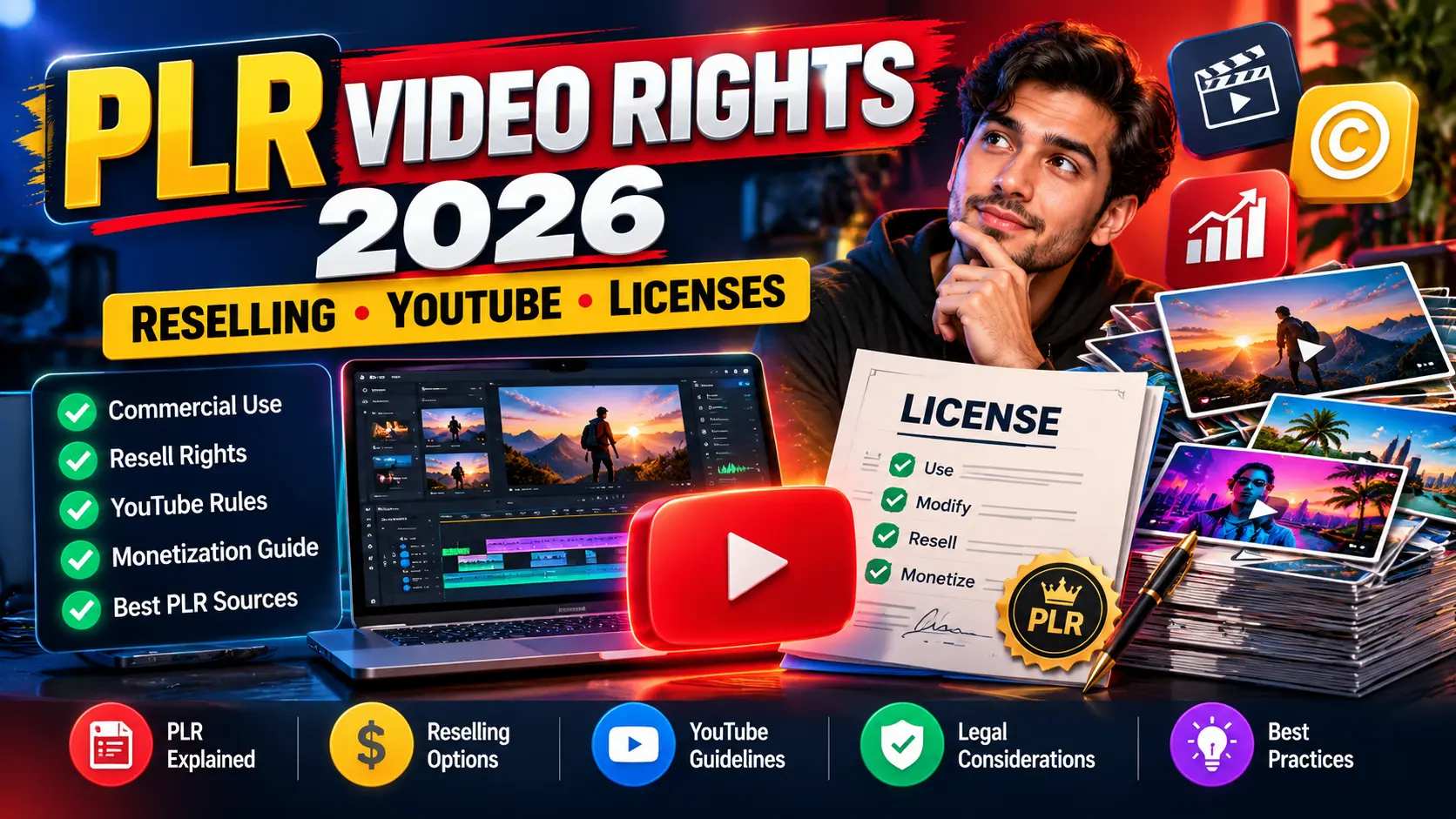
PLR video rights can look straightforward when a product promises ready-made videos, editable scripts and permission to resell. But three questions must be answered separately: What does the license legally allow? Will a platform accept the content? And have you added enough original value for an audience to care? A downloadable pack labeled “PLR” does not automatically answer all three.
This 2026 guide explains how to inspect a video content license, what YouTube’s monetization and reused-content policies mean, and how to transform AI or pre-made video assets into genuinely useful published work. It draws on issues commonly raised by AI video and private-label-rights bundles, including our research into ready-made side-hustle videos. It is a practical editorial checklist, not legal advice or a ruling on any seller’s individual license.
PLR Video Rights in 2026: The Short Answer
PLR stands for private label rights. In digital product marketing it usually means the buyer gets specified permissions to adapt, brand or distribute content. The term describes a category of license agreements, not one universal legal permission. One seller might allow edited videos on your own social channels while forbidding resale of the raw source pack; another might permit resale to customers but forbid transferring PLR rights to those customers.
You need the actual terms supplied with the exact product. Rights to edit, publish, run advertising, sell downloads, create client deliverables and resell editable source files are separate permissions.
| Your intended use | What the license should explicitly permit | Additional check |
|---|---|---|
| Publish an edited video on your own channel | Modification, distribution and platform publication | Originality and platform monetization rules |
| Monetize with ads | Commercial use of video, music, visuals and voice | YouTube Partner Program eligibility |
| Use videos in client projects | Agency/client-delivery or sublicensing rights | Whether the client may edit or reuse final files |
| Sell a finished digital course | Paid distribution or derivative-product rights | Third-party asset and music restrictions |
| Resell the original video pack | Explicit resale of unmodified source content | Price floors, market restrictions and license-transfer conditions |
| Give customers the ability to resell again | Master resale rights or other expressly stated downstream rights | Whether rights can be passed to another buyer |
The matrix describes questions to ask, not rights automatically included in any particular purchase. When terms are silent, do not assume permission.
PLR vs MRR vs Resale Rights: The Differences Matter
Private Label Rights (PLR)
PLR is often marketed as a right to customize material under your own brand. Some licenses allow publishing edited derivatives; others also permit resale. Do not infer a fixed bundle of rights from the acronym alone. Ask whether the license covers modification, attribution requirements, use on social platforms and commercial campaigns.
Master Resale Rights (MRR)
MRR commonly refers to a license that allows purchasers to resell a product and transfer specified resale rights onward. But the exact rights depend on the license text. An MRR license may not give broad freedom to modify the original material or remove a creator’s trademarks.
Regular Resale Rights
Regular resale rights typically describe the ability to sell a specified finished product without transferring broader licensing rights. Buyers may or may not be allowed to modify it. Again, the seller’s written agreement is authoritative for that transaction.
Quick test: If the sales page says “resell it as your own,” look for the clauses describing whether you can resell the original pack, change its branding, distribute only rendered videos, or pass rights to customers. The answer is not determined by the button text.
Can You Monetize PLR Videos on YouTube?
A PLR license is not a YouTube monetization guarantee. YouTube distinguishes copyright permission from its own quality and originality requirements. For AI-generated visuals, our AI-generated image copyright guide explains additional authorship and rights questions. Even content that you are legally permitted to use may fail the platform’s reused-content or inauthentic-content monetization policies if your channel mainly publishes barely changed material or repetitive templates without enough original value.
According to YouTube’s official monetization guidance, creators must have the commercial rights needed to use the visual and audio elements, and monetizable content must meet originality requirements. A seller granting redistribution permission does not make the resulting upload automatically original.
The practical question is therefore not simply “Can I upload this video?” It is also “What did I contribute that makes this genuinely different, more useful and identifiable as my work?” Narration based on your research, new demonstrations, substantial explanation and unique case studies are more defensible improvements than changing only a logo or background soundtrack.
What YouTube Calls Reused and Inauthentic Content
YouTube’s 2025 policy update clarified that repetitive or mass-produced videos can fall under its inauthentic content category. Its reused-content policy addresses repurposed material that lacks significant commentary, substantive changes or educational or entertainment value. Those are separate from copyright enforcement. The platform can decide that a licensed video is unsuitable for monetization even without receiving a copyright complaint. Read the YouTube Partner Program policy.
Changes that may add real value
- Original analysis: add real examples, comparisons or documented tests rather than simply reading someone else’s script.
- A new story: restructure an asset around a relevant audience, problem, case study or outcome.
- Expert explanation: explain what the viewer should do and why, with unique judgment and actionable steps.
- Meaningful demonstration: show your own workflow, interface or before-and-after example with accurate context.
- Human editorial control: check accuracy, rewrite weak sections and remove repetition across videos.
- Distinct visuals and pacing: replace generic repeated scenes where they fail to support the new narrative.
Changes that are usually not enough by themselves
- Replacing the intro, logo or channel name while keeping the same narrative and scenes.
- Making the identical video slightly shorter or slower.
- Changing only background music or a color filter.
- Uploading a series of near-identical template videos with different product names.
- Reposting the source files across multiple channels with minimal unique substance.
No checklist can guarantee approval because YouTube reviews actual channels and videos in context. The objective is to create legitimate original value, not to disguise duplicate files.
Eight License Clauses to Read Before Buying AI PLR Videos
- Who grants the rights? Identify the seller, copyright owner and the assets covered.
- May you edit? Check whether source files, scripts, graphics and subtitles can be modified and whether attribution is required.
- May you monetize? Look for explicit commercial-use permissions covering ads, affiliate links and paid promotion.
- May you resell? Distinguish resale of a finished derivative from selling the raw original pack.
- May you work for clients? Check agency permissions and whether finished work may be transferred to a paying customer.
- What about bundled media? Background music, voices, stock footage, character images and logos may have separate licenses.
- Can rights be transferred? Determine whether customers receive use rights, resale rights or no further rights.
- What restrictions apply? Look for prohibited marketplaces, minimum prices, refund restrictions, attribution conditions, and expiration provisions.
Save a dated copy of the license, invoice and source-files inventory. If a product page and downloadable license disagree, ask the seller for clarification before distributing the material. Rights can depend on the jurisdiction and the contract’s wording.
Does a Commercial License Cover Every Included Asset?
Not necessarily. A video bundle may contain third-party music, stock clips, images or AI voices whose original licenses limit redistribution or sublicensing. The vendor’s own video-rights statement cannot grant rights it does not actually control. Check the supplied terms for individual components and ask for documentation when source materials are unclear.
For example, a seller might allow you to publish an edited video commercially while forbidding you from extracting and reselling the soundtrack separately. Another license might allow a music track on one branded channel but not permit inclusion in a resale pack. Do not confuse a broad “commercial” label with unrestricted ownership.
According to YouTube’s copyright guidance, permission, suitable licenses or legal exceptions may allow a use, but they do not automatically prevent Content ID claims or disputes. Plan for a way to replace restricted assets if a claim occurs.
Creative Commons Licenses Are Not All the Same
Some creators use Creative Commons materials alongside PLR video packs. The license codes matter. A license with NC restricts commercial use. A license with ND restricts sharing adaptations. For instance, CC BY-NC-ND 4.0 combines attribution, noncommercial and no-derivatives conditions. Such a license is not equivalent to broad paid resale rights.
Even where commercial adaptation is permitted, obligations such as attribution or share-alike conditions may apply. Review the exact license version and the specific material’s rights notice. Creative Commons terms and a paid PLR contract are different legal frameworks; one should not be substituted for the other.
How to Transform a PLR Video Into Useful, Original Content
Imagine you have a ready-made two-minute video covering “five AI tools for freelancers.” Publishing it unchanged alongside hundreds of similar uploads adds little reader value. A stronger workflow begins with your own audience question and builds an original explanation around the material.
Step 1: Choose one specific audience
A broad script about AI tools can become a guide for independent graphic designers, new teachers or small local retailers. Define the skill level, budget and task before touching the video timeline.
Step 2: Audit the source and the license
Record the video’s original claims, images, audio tracks and source files. Verify rights to modify, distribute and monetize each component. Remove anything you cannot substantiate or legally use.
Step 3: Rebuild the narrative
Write a fresh opening that explains the audience’s problem. Replace vague advice with concrete actions, demonstrations and warnings. If the source says a tool is “unlimited,” investigate its actual plan allowances instead of repeating the sales claim.
Step 4: Add original examples
Include a walkthrough you performed, a practical spreadsheet, screenshots of your own process, or a comparison rubric. Be clear about what you directly tested and what came from documentation.
Step 5: Replace repetitive visuals
Keep assets only when they support the new explanation and are licensed for reuse. Use readable on-screen text, meaningful screenshots, new diagrams and appropriate captions, rather than repetitive stock scenes.
Step 6: Review accessibility and accuracy
Correct the subtitles, speak at a natural pace, check audio levels and verify every claim. Captions should follow the actual narration; screenshots should be legible on mobile devices.
Step 7: Publish with transparent metadata
Use a title that matches the video’s real content rather than an exaggerated income promise. Write an original description, identify relevant sources and disclose affiliate relationships where appropriate. Follow each platform’s rules on synthetic media disclosures when applicable.
Step 8: Measure actual usefulness
Track watch-time patterns, audience questions and meaningful engagement. Improve the videos viewers abandon, and create follow-ups that answer real questions rather than mass-producing slight variations of the same template.
A 10-Minute Rights Audit Worksheet
| Check | Answer to write down | Warning sign |
|---|---|---|
| Seller and product | Who is granting this permission? | No identifiable rights owner |
| Proof of license | Where is the dated written license? | Only a promotional headline |
| Commercial use | Can I run ads and monetize uploads? | Missing or contradictory terms |
| Editing | Can I rewrite and combine assets? | No clear derivative permission |
| Redistribution | Can I resell final videos? Source files? | “Resell” not defined |
| Music and stock | Are all included components cleared? | Unknown third-party origin |
| YouTube originality | What is my substantive contribution? | Only logo, music or color changes |
| Customer rights | What can my buyer do with the output? | Unclear downstream permission |
Keep this worksheet next to the receipt and source files. For larger bundles, repeat it for each type of asset instead of assuming all files are covered by one rule.
Are AI PLR Video Packs Worth Buying?
They can save production time when you already know the audience, possess the right to use the assets and plan to contribute original work. They make less sense when their principal appeal is the promise of uploading 100 nearly identical videos without editing. In that scenario, you may spend more time handling platform restrictions, licenses and weak viewer engagement than you save in production.
Before buying any content or video automation package, calculate the cost per genuinely useful finished video. Include acquisition cost, the time spent verifying rights, rewriting, visual changes, proofreading and distribution. A pack of many files is not good value if very few fit your audience or licensing needs.
For AI-generated video tools rather than pre-made assets, see our AI Video Credits Explained guide to assess usage costs. Our AI YouTube Multi-Channel Builder Review examines a different video workflow and the risks behind automation claims. To understand long-term software spending, consult AI lifetime deals vs subscriptions.
Frequently Asked Questions About PLR Video Rights
Can I legally resell PLR videos?
Only when the actual license grants the particular resale rights you need. Some licenses permit selling modified finished videos; others limit distribution or forbid reselling raw source files. Read the written terms rather than relying on the PLR label.
Can I monetize a PLR video on YouTube?
Commercial-use permission is necessary, but YouTube also applies separate originality and monetization requirements. A licensed, minimally modified video is not automatically eligible for ad revenue.
Is changing the logo enough to make a PLR video original?
No reliable rule says that. YouTube evaluates whether the material provides meaningful added commentary, substance or entertainment value. A different logo does not necessarily change the content’s substance.
Can I use PLR video content for client work?
Check whether your license authorizes commercial client delivery, sublicensing and use under another brand. The ability to publish on your own account does not automatically mean you can transfer rights to a paying client.
Do I own copyright in a PLR pack I purchased?
A license typically gives specified rights to use material; it does not automatically transfer full copyright ownership. Ownership and copyright assignment depend on the written agreement and applicable law.
Can I upload the same PLR video to several channels?
Even if the license permits the uploads, repeated identical or near-identical material can conflict with platform policies on reused or inauthentic content. Consider audience value and platform rules before redistributing the same files at scale.
What if I receive a Content ID claim?
Check which audio or visual component triggered it, confirm your rights and follow the platform’s claim-resolution process. Keep proof of licenses and consider replacing assets where you cannot establish authorization.
Final Verdict: Verify Rights, Then Add Distinctive Value
The most important lesson about PLR video rights is that a license, platform monetization eligibility and original creative value are three separate things. Read the agreement for your precise use, verify rights to every component, and build a video that clearly contributes something valuable. That approach is more sustainable than treating ready-made content as guaranteed resale inventory or automatic YouTube income.
Official resources: YouTube channel monetization and reused-content policies; What content can be monetized?; YouTube copyright guidance; Creative Commons BY-NC-ND license example. Editorial check: October 13, 2026. Rights depend on each actual contract and platform policy, which may change.