
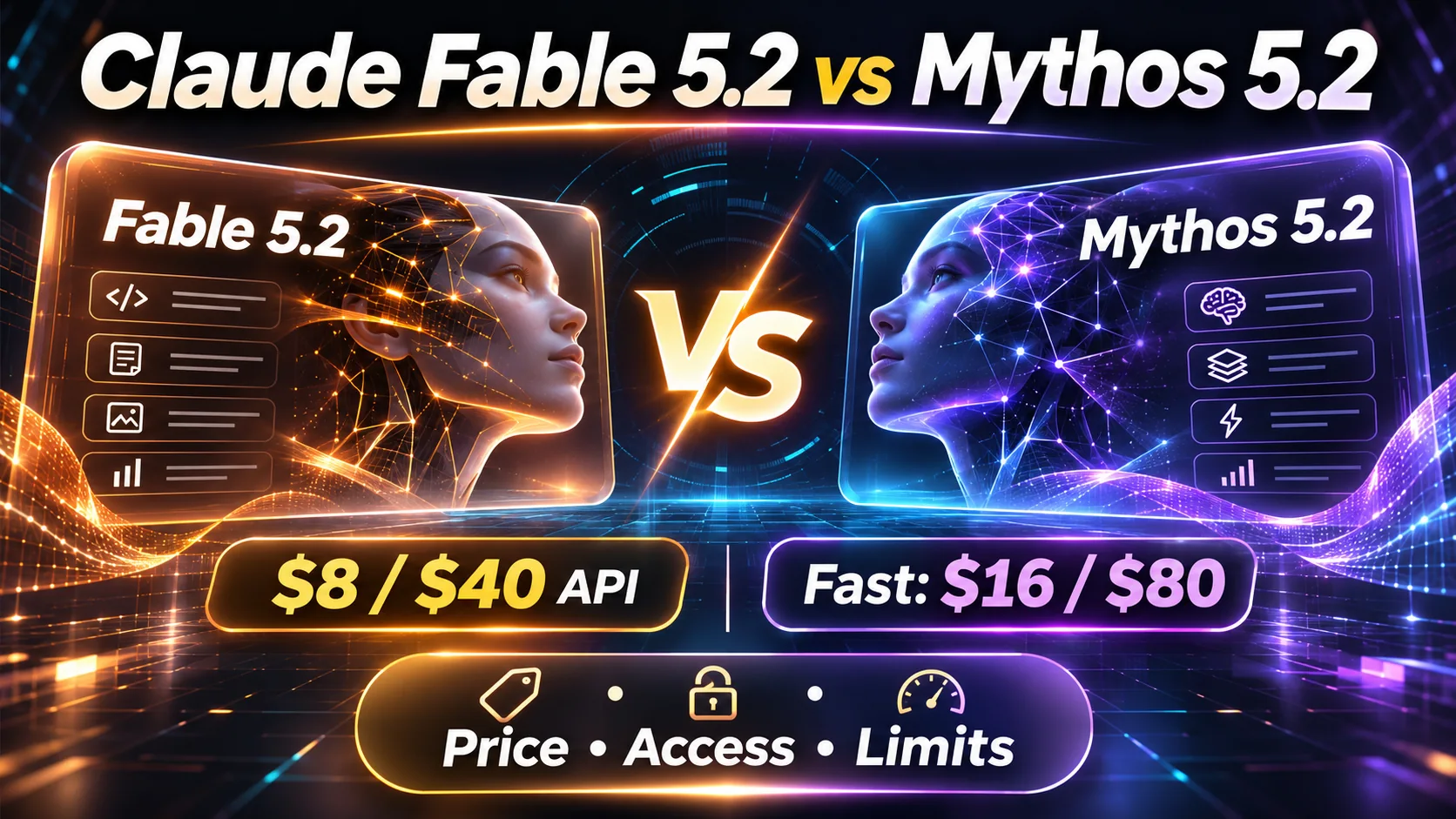
Claude Fable 5.2 vs Mythos 5.2 — Claude Fable 5.2 vs Mythos 5.2 is a timely question after Anthropic’s November 9, 2026 launch. These are not simply two competing intelligence tiers. Anthropic says they share the same underlying model, while Fable adds safeguards that support wider access and Mythos is reserved for approved organizations working in specific technical areas. Both list $8 per million input tokens and $40 per million output tokens. This comparison clarifies real access rules, fast mode and when an upgrade makes sense.
Last fact-checked: November 10, 2026. This is a source-based educational explainer, not a paid performance benchmark or a promise of free access. Model prices and account availability may change. We separate official announcements from our practical recommendations.
Claude Fable 5.2 vs Mythos 5.2: the essentials
- Claude Fable 5.2 and Claude Mythos 5.2 were announced on November 9, 2026 and share a common underlying model.
- Fable 5.2 has additional safeguards in sensitive areas and is generally available; Mythos 5.2 access is limited to vetted organizations.
- Both list $8 per million input and $40 per million output tokens; optional fast mode is priced at $16/$80 per million.
- Fable’s documented API model ID is claude-fable-5-2; access to Mythos is through verification programs.
- A large context window does not remove the need for privacy controls, evaluation and accurate source verification.
Claude Fable 5.2 vs Mythos 5.2: comparison at a glance
| Area | Claude Fable 5.2 | Claude Mythos 5.2 |
|---|---|---|
| Underlying model | Shared Fable/Mythos architecture | Shared Fable/Mythos architecture |
| Primary access | General availability on supported platforms | Vetted programs and approved organizations |
| Safeguard policy | Additional cyber/biology restrictions | Different policy for approved use cases |
| Input price | $8 / 1M tokens | $8 / 1M tokens |
| Output price | $40 / 1M tokens | $40 / 1M tokens |
| Optional fast mode | $16/$80 per 1M | $16/$80 per 1M, if approved |
| Best candidate | General difficult analysis, coding, documents | Authorized specialized research |
What did Anthropic announce on November 9?
Anthropic updated its highest-complexity Fable/Mythos model family and emphasized improvements to coding, reasoning, vision and difficult technical work. The announcement also describes faster output than the preceding 5.1 releases and lower API pricing. Those figures are vendor measurements, not guaranteed improvements for every task.
Importantly, Anthropic says Fable 5.2 and Mythos 5.2 are the same underlying model. The public-facing distinction is largely safeguards and eligibility. That is why a fair comparison must focus on permitted use cases, billing and operational fit rather than inventing two separate benchmark rankings.
Users should not interpret the Mythos name as a secret premium mode that ordinary subscribers can unlock with a special prompt. For restricted technical research, organizations must use the provider’s formal verification process.
Claude Fable 5.2 vs Mythos 5.2: actual differences
Fable is designed for broad professional use, including long-form research, software engineering and detailed analysis. It carries additional restrictions for some cybersecurity and biology tasks. Anthropic documents model behavior and fallback policies so developers should be prepared for certain requests to be blocked or redirected.
Mythos is offered to vetted organizations in specific beneficial cybersecurity or life-sciences programs. The access distinction matters because a developer cannot assume a Mythos identifier will work in a standard account. Check approved status and the exact cloud platform before building an integration.
Because capabilities come from the same underlying model, the comparison should measure differences in authorization and task handling, not market Mythos as universally smarter. When Fable handles your workload, the general availability is often the practical advantage.
API pricing, caching and cost example
Both models list $8 per million input tokens and $40 per million output tokens at standard speed. For example, 100,000 input tokens cost $0.80 and 20,000 generated tokens cost $0.80. The basic calculation totals $1.60 before any other charges or pricing modifiers.
Anthropic also lists prompt caching rates: a five-minute cache write is $10 per million tokens, a one-hour write is $16, and cache reads are $0.20 per million. These rates can make repeated stable context cheaper, but only when the application actually uses caching as documented.
Batch processing is separately described at a fifty-percent discount on standard input and output rates. Do not automatically apply batch or cache reductions to every chat; first confirm platform and feature eligibility, then measure actual usage in the console.
Is Claude Fable 5.2 fast mode worth it?
Fast mode is optional. Anthropic says it can increase output tokens per second by up to 2.5 times while using the same underlying model, but speed improvements vary with workload. It is not a promise of instant time to first token.
The published fast-mode price is $16 per million input tokens and $80 per million output tokens. In the earlier 100,000-input/20,000-output example, fast mode works out to $1.60 input plus $1.60 output, or $3.20 in standard token terms before modifiers.
Use it for interactive developer tasks where waiting reduces productivity. For overnight batch analysis or long jobs without a human waiting, standard speed can be more economical. Always evaluate the cost of a successful task rather than tokens alone.
Context length and model behavior
Anthropic’s Fable 5.2 model page lists a one-million-token context window and a maximum output of 128,000 tokens. These are maximum capabilities, not a promise that every task should use an enormous prompt. Large inputs still require careful organization and can be expensive.
Fable 5.2 uses adaptive thinking, which Anthropic says is always enabled. Rather than attempting to disable it, developers should set effort levels and measure whether additional thinking improves the results of a difficult task.
Model output should still be checked against source documents and automated tests. A large context window can hold more material, but it cannot automatically distinguish valid and stale information without a review process.
How to choose the right Claude model: seven steps
Step 1 — Decide whether your task is ordinary writing, professional analysis, multi-file coding or a regulated research use case. Avoid buying the highest tier before defining the job.
Step 2 — Check your actual product surface: Claude app, Claude Platform, a cloud partner or Claude Code. Access to a model and billing can differ by surface.
Step 3 — Start with an established model such as Opus or Sonnet for an affordable baseline. Anthropic’s migration guidance recommends evaluating Fable when a simpler option is not sufficient.
Step 4 — Build a small test set with expected answers, reference documents and real code checks. Keep the same test inputs across models.
Step 5 — Measure accuracy, tool errors, refusals, latency and tokens. For a migration, also review compatibility changes to thinking blocks, tool versions and parameters.
Step 6 — If you need Mythos for an authorized research program, apply through Anthropic’s official verification process. Do not try to bypass account restrictions.
Step 7 — Document which model and speed you selected and why. Review the decision when release details, prices or organizational needs change.
Developer migration mistakes to avoid
Anthropic’s 5.2 migration documentation flags behavior that may break older integrations. In particular, earlier computer-use tool versions may no longer be accepted and thinking blocks can have account-bound handling. Treat a model swap as an application change requiring regression tests.
Developers should review tool schemas, reasoning settings, persisted conversation history and refusal handling. If you send unsupported request fields or assume old defaults, the API may return an error even if your prompt worked with a previous model.
Do not paste sensitive production keys into debugging examples. Use a limited test environment and inspect the current documentation before deploying an app that acts on customers’ behalf.
Privacy and availability restrictions
Anthropic’s model documentation notes that Fable 5.2 has specific data-retention requirements and is not automatically covered by zero-data-retention terms without express authorization. Organizations with strict retention obligations must check the rules for their contract, host and use case.
Mythos is not a general public subscription toggle. Cybersecurity and life-science access is conditional on verification. Account eligibility, region and enterprise terms should be confirmed before promising clients a specific model.
For everyday users, a model name alone does not guarantee better work. Pick the least complex option that meets the quality and safety threshold, then upgrade only when real measurements justify it.
Claude Fable 5.2 vs Mythos 5.2: frequently asked questions
What is the difference between Claude Fable 5.2 and Mythos 5.2?
They share the same underlying model, while Fable includes additional safeguards for broad use and Mythos is limited to approved organizations with eligible use cases.
Is Claude Mythos 5.2 available to everyone?
No. Anthropic describes access through verified cybersecurity or life-science programs and other approved enterprise arrangements.
What does Claude Fable 5.2 cost?
The standard API list price is $8 input and $40 output per million tokens; caching, batch processing, hosting and fast mode have additional rules.
What does the fast option cost?
Anthropic lists $16 input and $80 output per million tokens in fast mode, with a claimed output-speed improvement of up to 2.5 times.
Does Fable 5.2 have a one-million-token context window?
The official model overview lists 1M context tokens and up to 128K output tokens. Limits and actual usability can depend on the platform and account.
Claude Fable 5.2 vs Mythos 5.2: final recommendation
For most developers, start with a supported Claude model that already passes your evaluations and consider Fable 5.2 when a difficult task needs deeper reasoning. Mythos access is a matter of eligibility, not an ordinary performance upgrade. Compare actual costs, latency and reliability rather than choosing by the largest model name.
Official sources and further reading
Primary source documents: Anthropic’s official Fable/Mythos 5.2 launch and Fable 5.2 official model specifications. We checked official release dates, model availability and price notes rather than relying on unverified third-party launch claims.
More practical guides on AIReviewDock.com: Claude message threads API guide and AI API tokens and caching cost guide.
For separate product and offer evaluations on AIReviewDock.online, see ClaudeX 5.5 review and NEURA AI review. Those commercial reviews are distinct from this educational guide.