
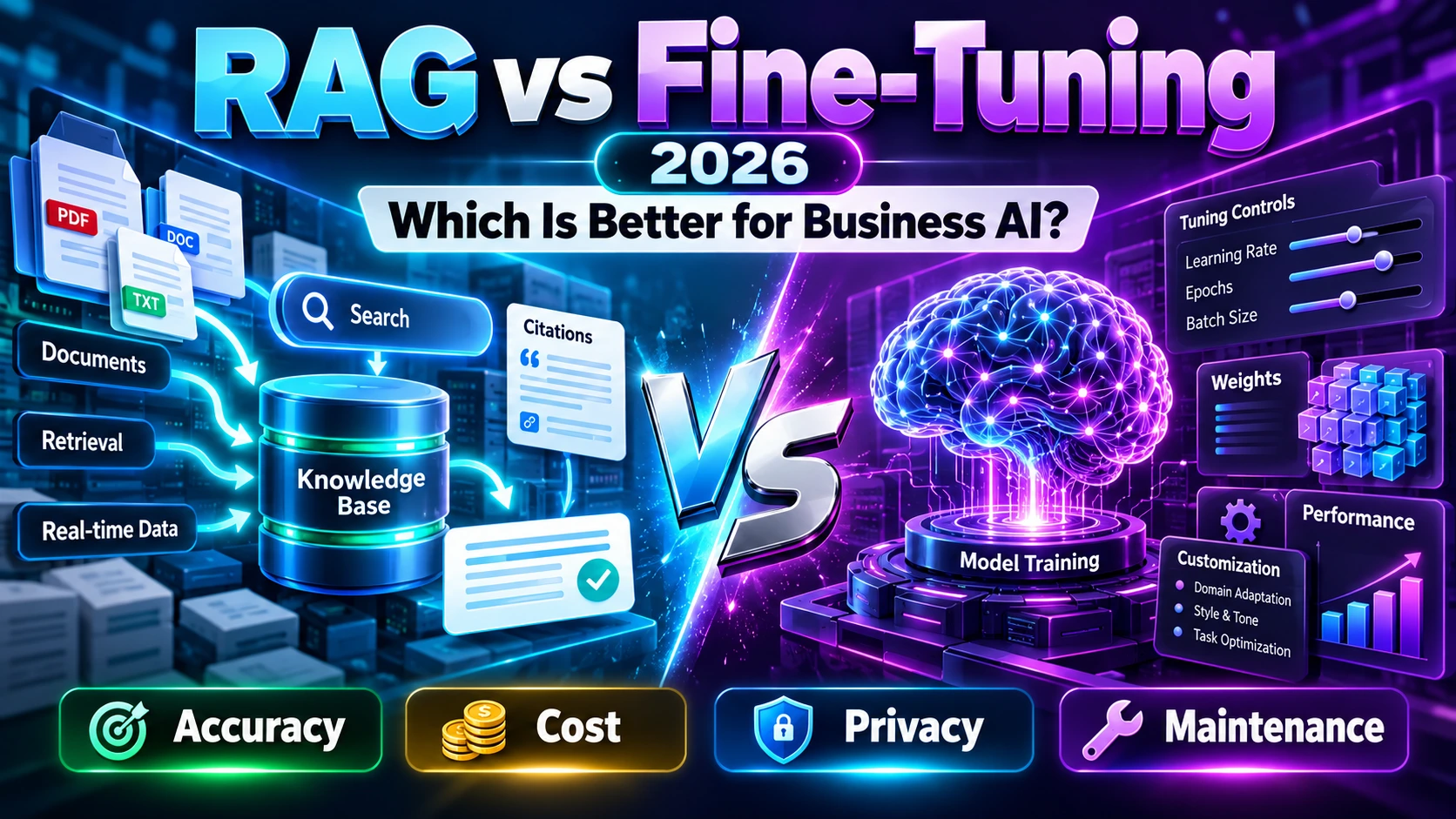
Short answer: A RAG vs fine-tuning choice depends on whether your assistant needs current evidence or more consistent learned behavior. If you want an AI assistant to answer questions using updatable business documents, retrieval-augmented generation (RAG) is often the better starting point. If you want a model to follow a specialized pattern, tone or classification format consistently, fine-tuning may help after you have a high-quality set of examples. Neither method automatically guarantees factual accuracy.
This RAG vs fine-tuning guide for 2026 compares both approaches for practical decisions: customer support, internal knowledge, product data and standardized workflows. It is an educational comparison, not a claim that AI Review Dock has tested every commercial platform.
What is RAG?
Retrieval-augmented generation connects a language model to information stored outside its parameters. Before generating a response, a retrieval system searches selected material—such as approved help articles, product manuals or policy PDFs—and supplies relevant excerpts to the model. The response can then be grounded in this retrieved evidence.
For example, imagine a software business updates its refund policy on Monday. A RAG-based support assistant may retrieve the newest approved policy page on Tuesday, provided its index is current and its access controls work. A general model that has not seen the update would not automatically know the new terms.
In practice, typical RAG components include a document source, ingestion and chunking pipeline, search or vector index, permission checks, retrieval/reranking, a prompt to the language model, and monitoring. Not every application requires a vector database: keyword search or hybrid retrieval can also be useful.
What is fine-tuning?
Fine-tuning changes an existing model through additional training on a selected dataset. In a supervised setup, these examples demonstrate desirable input-output behavior. For business use, this can mean learning a fixed labeling scheme, structured format, specialized writing style, or a recurrent domain task.
For example, a business may collect hundreds of carefully labeled customer messages. A model could be fine-tuned to output consistent categories and structured fields. However, retraining is not a reliable way to keep frequently changing facts such as today’s prices or inventory levels current.
However, fine-tuning availability, model choices, training method, data requirements and pricing differ by platform. Some services offer hosted fine-tuning, while others require engineering and additional infrastructure.
RAG vs fine-tuning: side-by-side comparison
| Decision factor | RAG | Fine-tuning |
|---|---|---|
| Primary goal | Use relevant external knowledge when answering | Improve a model’s learned task behavior |
| Changing facts | Can be updated by refreshing source documents and indexes | Generally requires a new data/training strategy for new information |
| Source citations | Can attach references to retrieved passages | Does not itself provide verifiable source references |
| Implementation effort | Retrieval quality, ingestion and permissions | Training examples, evaluation and tuning pipeline |
| Typical failure | Wrong passage retrieved or insufficient evidence | Overfitting, stale facts or brittle behavior |
| Best initial use | Policy/manual/document Q&A | Repeatable classification and formatting tasks |
AWS Prescriptive Guidance and IBM’s technical comparison describe the underlying trade-offs. Both approaches can also be combined.
1. How should a business choose between them?
First, start with the problem, not the technology. Write down examples of questions the system must answer, how often the source facts change, how much mistake risk is acceptable, and whether users need citations. Next ask whether a strong base model with a clear prompt can already do the job. Only add a complex retrieval or training pipeline when evaluation shows a real need.
For example, a small restaurant might need an internal assistant to find menu allergen statements and shift procedures. RAG with approved documentation, explicit source links and strong permission controls is a sensible prototype. A marketing agency that needs to classify thousands of standardized leads might benefit from simpler prompt-based extraction first, followed by fine-tuning if consistency remains weak.
2. Accuracy: which approach hallucinates less?
Importantly, neither technique makes an AI factual by default. RAG improves the model’s access to relevant evidence when retrieval succeeds. If the retrieval engine returns an outdated policy or unrelated paragraph, the answer may still be wrong. Fine-tuning can improve performance on representative tasks but may still invent details when asked questions outside its training examples.
For sensitive workflows, design an “I don’t have enough evidence” response. Evaluate factual answers against authoritative sources and have humans review high-impact outputs. IBM’s RAG overview describes the role of source retrieval; citations are only useful when they truly support the claimed fact.
3. Costs: what do you really pay for?
RAG costs may include document ingestion, extracting text, embeddings, search-index storage, retrieval queries, reranking and the model’s input/output tokens. Every time you send retrieved passages into the prompt, they consume context. Retrieval can reduce waste if it prevents sending entire documents, but building and maintaining an index costs time.
Fine-tuning costs may include data annotation and cleaning, training or adapter jobs, evaluations, model hosting and ongoing retuning. Some platforms also charge different inference rates for fine-tuned models. The cheaper choice depends on how many requests you handle and the sophistication of the task.
For a broader comparison of software costs over time, see our AI lifetime deals versus subscriptions guide. In RAG and fine-tuning projects, compare cost per correct and useful answer rather than the price of a single call.
4. Privacy and permission boundaries
If data must remain within infrastructure you operate, compare deployment responsibilities using our self-hosted LLM guide. Hosting locally does not itself solve source permissions or model accuracy.
Meanwhile, knowledge bases often contain confidential files. A RAG system must enforce user permissions before retrieval results reach the model. It should not return a private salary file just because a prompt resembles its content. Logging, retention and source access should follow company policy.
Fine-tuning has a different governance question: are you allowed to train on the examples, and could personal or restricted data be memorized or disclosed? Use data minimization, careful access control and vendor-specific retention controls. Our AI tool privacy checklist offers vendor due-diligence questions before sending confidential material to any platform.
5. Maintenance: which one stays useful longer?
For ongoing maintenance, RAG gives teams a direct route for correcting outdated information: update the original document and make sure the search index refreshes. But index drift, duplicate content, broken permissions and poorly split paragraphs require monitoring. Some business questions are better answered by structured APIs or database queries instead of document retrieval.
By contrast, fine-tuned models require regular evaluation as products, writing styles and business requirements evolve. New categories or policy changes can reduce performance. A model trained to recognize five ticket categories may struggle when the company introduces a sixth.
6. When should you combine RAG and fine-tuning?
In some cases, combining approaches can make sense when the assistant needs both current knowledge and a specific output format. Imagine a technical support assistant that must cite the current help center while always returning a structured troubleshooting checklist. The RAG component supplies documentation; task tuning may improve the consistent response structure.
But do not start with both by default. Begin with a trustworthy baseline, measure failure patterns, and add the next component only after you know what is failing.
7. A 30-minute proof-of-concept evaluation
Many document-retrieval pilots need clean text and preserved headings. The PDF-to-Markdown conversion guide explains how to prepare and validate source documents before testing RAG retrieval.
- Gather 20 real questions: Include easy, ambiguous, outdated and permission-sensitive examples.
- Choose an authoritative source: Use an approved document set that already has version dates.
- Record the baseline: Run the same questions using a standard model and clear instructions.
- Test retrieval: Add only relevant excerpts, note their sources, and inspect whether retrieval found the correct sections.
- Score responses: Mark factual accuracy, completeness, citation support, safe refusal and latency.
- Estimate operations: Count the effort to clean documents and keep the pipeline accurate.
- Decide whether tuning is needed: If facts are right but formatting is inconsistent, improve prompting before investing in fine-tuning.
For a fair comparison, keep the same test questions when comparing methods. Otherwise a more expensive configuration might appear better only because the evaluation changed. Track both average performance and the worst failures.
8. Common mistakes to avoid
- Assuming a vector database automatically knows which document is correct.
- Training a model just to add facts that change weekly.
- Using confidential datasets without permissions or appropriate controls.
- Judging accuracy only by fluent writing rather than checking source evidence.
- Ignoring costs from search, storage, annotation and engineering time.
- Declaring a workflow fully autonomous without human escalation paths.
FAQ
Can I build RAG without fine-tuning?
Yes. Many document-grounded assistants use a pretrained model with retrieval and no additional model training.
Is fine-tuning a replacement for a search engine?
No. Fine-tuning modifies learned behavior, not a live search index. Current facts and source references usually require separate data access.
Do small businesses need a vector database?
Not always. Smaller collections may work with keyword search or a hybrid system. Choose based on the kinds of questions, the documents and measured retrieval quality.
Can I use both approaches together?
Yes. It may help for complex workflows, but only after a simpler baseline shows clear shortcomings.
Bottom line
Ultimately, choose RAG first when answers depend on changing documents and verifiable references. Consider fine-tuning when repeatable behavior and formats remain weak after strong prompting. Use both when evaluation proves that each solves a different, meaningful failure. Security, testing and maintainability are more important than the newest label.
Sources checked October 18, 2026: AWS RAG vs fine-tuning guidance, IBM comparison, and IBM RAG overview.