
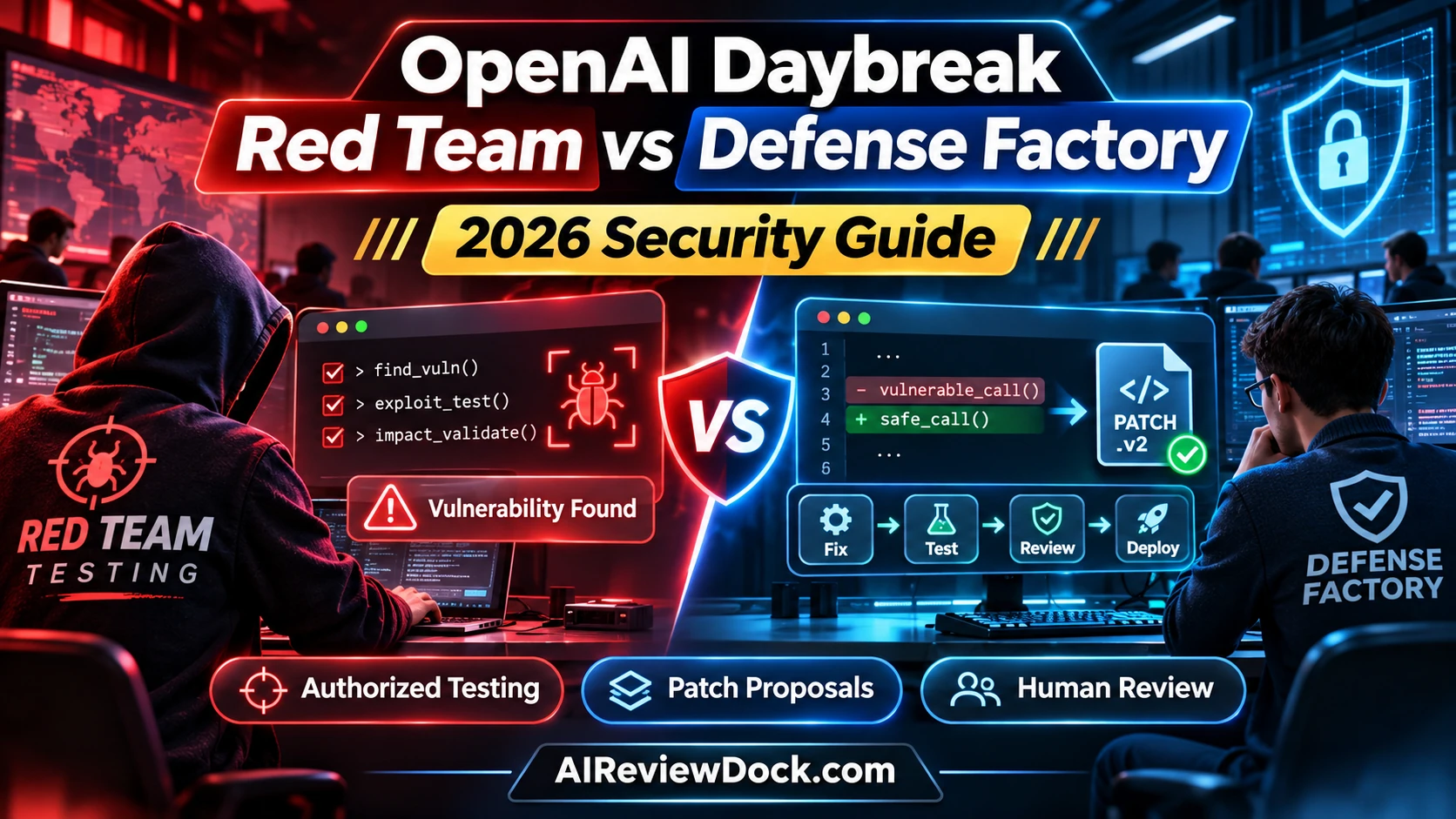
OpenAI Daybreak Red Team vs Defense Factory — OpenAI Daybreak Red Team vs Defense Factory compares two cybersecurity products that OpenAI announced during its November 12, 2026 Cyber at the Frontier event. Daybreak Red Team uses coordinated agents to examine authorized web applications, validate findings and retest whether fixes work. Daybreak Defense Factory focuses on taking identified vulnerabilities and preparing suggested patches for engineers to review. They are related but not interchangeable products, and neither gives unrestricted permission to attack an arbitrary website.
Updated November 14, 2026. We wrote this guide using the vendor’s official documents. Features and access may change during rollout; we have not run a paid hands-on benchmark.
OpenAI Daybreak Red Team vs Defense Factory: quick answer
| Question | Current information |
|---|---|
| Event | Cyber at the Frontier, November 12, 2026 |
| Red Team role | Authorized security testing and vulnerability validation |
| Defense Factory role | Investigate findings and prepare patches for human review |
| Source of findings | Testing agents, scanners, bounty reports and other approved tools |
| Red Team access | Early access by organization inquiry; approval not guaranteed |
| Defense Factory access | Preview for eligible Daybreak workspaces; confirm current rollout |
| Patch approval | Engineers review and test changes before merging |
| Public pricing | No independently confirmed standard public price |
What is OpenAI Daybreak Red Team and Defense Factory?
First, OpenAI Daybreak Red Team vs Defense Factory compares two cybersecurity products that OpenAI announced during its November 12, 2026 Cyber at the Frontier event. Daybreak Red Team uses coordinated agents to examine authorized web applications, validate findings and retest whether fixes work. Daybreak Defense Factory focuses on taking identified vulnerabilities and preparing suggested patches for engineers to review. They are related but not interchangeable products, and neither gives unrestricted permission to attack an arbitrary website.
Above all, start by defining your task and checking that you have permission to carry it out. New AI tools may save time, but teams still need clear access rules, reliable results and named owners. Also, the vendor may not have enabled every advertised feature for every organization yet.
OpenAI Daybreak Red Team and Defense Factory: seven important capabilities
1. Red Team examines an authorized attack surface
Specifically, OpenAI designed Red Team for a specific app and a test scope that an authorized owner defines. Its coordinated agents use application source code and context to investigate possible paths and confirm weaknesses. This is different from asking a general chat assistant for security advice, and successful deployment requires written scope and defined test environments.
2. Vulnerability validation is a separate step
For example, a static scanner can report possible defects that are not exploitable in the current environment. A validation workflow attempts to establish whether a finding represents a real issue inside the approved scope. Evidence should distinguish a verified issue, a false positive and an inconclusive report; no team should use an unreviewed AI label as a final severity assessment.
3. Isolation and boundary controls
Moreover, OpenAI describes isolated environments and Guardian review to enforce where Red Team agents may operate. A security leader should still confirm which endpoints, credentials, tenants and data types the team may use before testing. Limitations on scope are a protective design feature rather than an obstacle to bypass.
4. Defense Factory starts from a finding
By contrast, defense Factory can receive the output of Red Team or existing security software and use agents to investigate a vulnerability in a codebase. It develops a patch proposal and attaches a rationale so a developer can understand the change. This workflow helps teams prepare fixes, but it cannot fix every issue automatically.
5. Human review and testing remain necessary
Even so, proposed changes should go through code review, unit tests, integration tests, deployment gates and monitoring. OpenAI says engineers review and test patches before merge. An apparently correct patch can create a regression, fail under production configuration or leave part of the attack surface untouched.
6. Codex can help explain and refine a patch
Additionally, the Defense Factory product describes a workflow where engineers provide context, inspect evidence and work with Codex to tune a suggested fix. This is useful when a vulnerability spans several files, but access to the repository must remain scoped and engineers must handle source material according to company security policy.
7. Continuous checks need governance
Meanwhile, connecting a repository and rechecking new commits can shorten a queue of known security work. Yet repeated scans also create operational cost, false positives and noise. A mature process assigns owners, sets escalation rules and records the exact code revision that testers checked.
OpenAI Daybreak Red Team vs Defense Factory: step-by-step implementation
To begin, run a small pilot with the right permissions. The steps below give you a practical checklist; they do not claim that we tested the product ourselves. Keep records of permissions, errors and the final result that a person approves.
Step 1: Confirm legal authority and risk tolerance
First, only test applications that your organization owns or has explicit written authorization to assess. Define permitted hosts, environments, working hours, accounts and rules of engagement before any scanner or agent runs.
Step 2: Create an asset and threat inventory
Next, map critical services, data flows and access boundaries. Prioritize applications handling credentials, payments or personal information; keep staging separated from production.
Step 3: Obtain the appropriate Daybreak access
Then, Daybreak has separate authorization paths and product eligibility. Request access through official channels; approval for a defensive access program does not imply unrestricted Red Team access.
Step 4: Run a bounded validation workflow
After that, start with one approved test application and a small finding list. Validate reported issues under the agreed scope and review the evidence before accepting severity labels.
Step 5: Send verified issues to remediation
Next, use Defense Factory or your established engineering tools to prepare a narrowly scoped fix. Link the suggestion to the original finding, affected revision and reproduction conditions.
Step 6: Review, test and approve patches
Importantly, assign a developer and security reviewer. Run automated tests and inspect unintended changes. Do not bypass normal CI/CD controls just because an agent suggested a patch.
Step 7: Retest and document closure
Finally, verify that the original weakness is no longer present in the approved environment, record the change and establish a repeatable schedule for future code changes.
OpenAI Daybreak Red Team and Defense Factory: plans, features and limitations compared
| Decision | Daybreak Red Team | Daybreak Defense Factory |
|---|---|---|
| Primary job | Validate whether an authorized web application has a weakness | Investigate findings and propose code fixes |
| Main input | Application, source context and controlled test scope | Verified findings and connected repository context |
| Output | Evidence and vulnerability validation report | Draft patch and engineering review materials |
| Human responsibility | Authorizing scope and assessing findings | Reviewing, testing and merging patch |
| Typical user | Authorized application security or red teams | Developers, DevSecOps and remediation engineers |
| Availability | Early access inquiry | Eligible preview/workspace access |
| Can guarantee a secure system? | No | No |
Three real-world workflows for OpenAI Daybreak Red Team and Defense Factory
Security backlog triage
For example, a software team may have dozens of automated scanner alerts. The first goal is to group duplicates and validate important risks, not to generate patches for every warning blindly.
Web application release review
Similarly, an application owner can authorize bounded testing before a major update. Findings can feed engineering review, and engineers should retest each resolved issue against the candidate release.
Continuous secure development
Over time, a mature organization may connect approved repositories for recurring checks, assign action owners and keep human quality gates. Production deployment still requires separate approval and monitoring.
Practical safety and adoption checklist
- Obtain explicit permission and define a narrow testing scope.
- Preserve separate credentials for testing and production environments.
- Protect sensitive code, secrets and customer information.
- Treat initial model findings as hypotheses requiring evidence.
- Require human approval for every proposed code change.
- Run regression tests and preserve a working rollback.
- Record remediations and retest relevant vulnerabilities on a controlled schedule.
Therefore, a polished demo is only a starting point. Set clear owners, usage limits, success measures and steps for handling exceptions. Teams with high privacy or security requirements should check vendor documentation and internal policy before enabling integrations.
Related guides and alternatives to OpenAI Daybreak Red Team and Defense Factory
For foundational guidance on AIReviewDock.com, see safe coding agent workflows guide and AI data governance checklist. These address durable workflow principles rather than duplicating this launch announcement.
Likewise, our separate AIReviewDock.online review site also covers adjacent tools, including Click Action AI review and RoboTek AI review. Those commercial products serve different use cases and should not be mistaken for the service evaluated here.
OpenAI Daybreak Red Team vs Defense Factory: frequently asked questions
What is the difference between Daybreak Red Team and Defense Factory?
In short, red Team tests and validates vulnerabilities in authorized apps; Defense Factory investigates findings and prepares patch proposals for engineers.
Can anyone use Daybreak Red Team immediately?
No. The product page indicates early access by inquiry. Approval and organizational requirements apply.
Does Daybreak Defense Factory deploy fixes automatically?
Also, OpenAI says developers review and test patches before they merge them. Do not assume autonomous production deployment.
Is Daybreak the same thing as GPT-6 Cyber?
Meanwhile, Daybreak is a broader cybersecurity program with access levels and products. A specialized model may require separate approval and is not automatically enabled with every product.
What does Daybreak cost?
Currently, we could not verify a standard public price on the official product pages. Teams should request current commercial terms directly.
Can I test a competitor’s website?
Of course, only with explicit permission and a defined legal scope. Access to an AI testing tool does not grant authorization to attack third-party systems.
Is Defense Factory a replacement for a security engineer?
No. It can prepare remediation suggestions, but engineering and security reviewers remain responsible for correctness and deployment.
For more on how OpenAI is building out its developer tooling, see our look at the Codex and Pierre acquisition and what it means for GitHub users.
Final recommendation for OpenAI Daybreak Red Team and Defense Factory
Overall, Daybreak Red Team is relevant to teams with a defined, authorized application-testing program; Defense Factory fits teams with a pipeline of findings and the engineering discipline to review patches. Do not judge either as a general ‘AI hacker’ tool. Access, permissions, test evidence and human governance determine whether the tools are suitable.
For this reason, keep a written plan and check current eligibility rules. Then test whether the workflow gives useful results while protecting consent, data and approval steps.
Official sources and methodology
Finally, primary references checked November 14, 2026: OpenAI’s Daybreak Red Team product page and OpenAI’s Daybreak Defense Factory product page. These examples explain the workflow; we do not claim to have bought the tools or used them in production.