
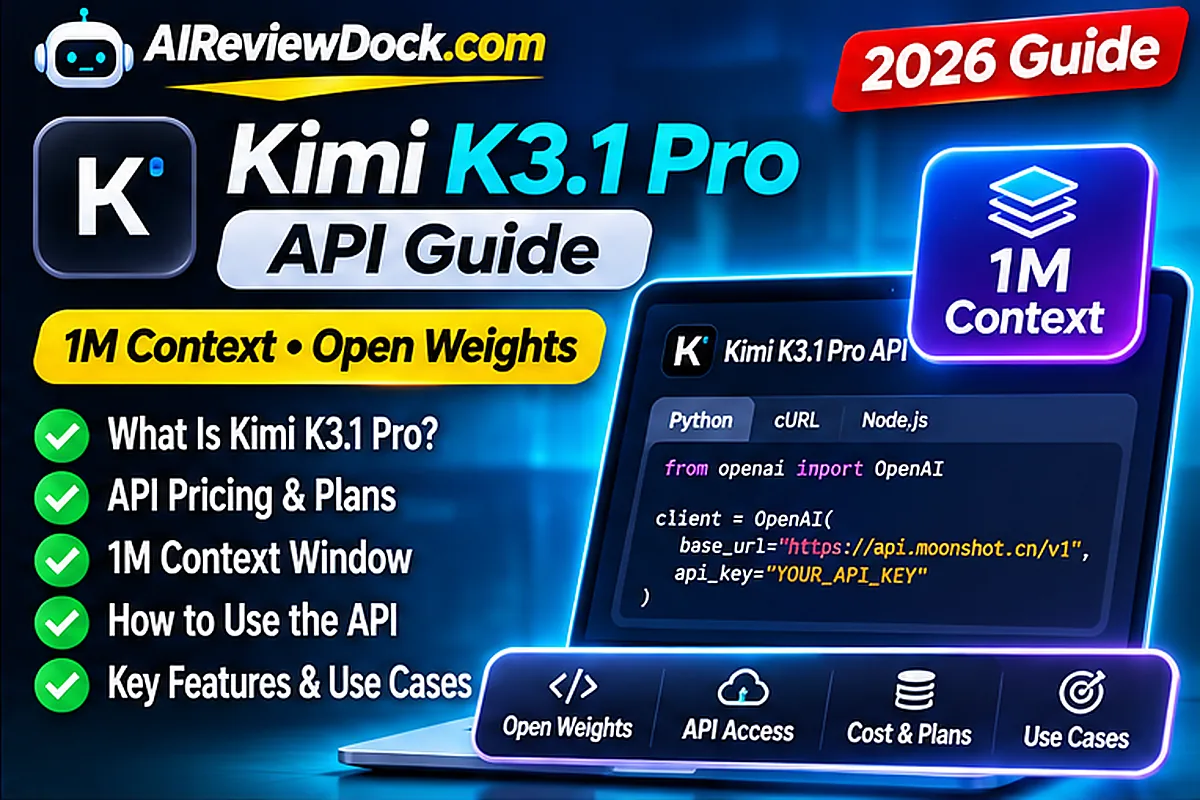
Kimi K3.1 Pro API pricing in 2026: Moonshot AI’s open-weight K3.1 Pro has become a timely developer topic as its weights and additional serverless availability drew attention on November 5. The model offers a documented context length of 1,048,576 tokens and accepts text and image inputs. Its mixture-of-experts architecture and API pricing make it relevant to software agents, research assistants and long-document workflows. This guide separates verified model specifications from marketing benchmarks and explains how a team can evaluate real costs before committing.
Kimi K3.1 Pro was introduced before November 5; the current news is wider access to open weights and hosting options. That distinction matters because a new hosting listing does not mean the entire model was first announced today. Published benchmark scores often use specific settings, prompts and evaluation harnesses. For a production buying decision, reproducibility, data handling, availability and cost per correctly completed task matter more than a headline rank.
Kimi K3.1 Pro API Pricing: Confirmed Specifications
Moonshot’s official model card describes native multimodal capability, the 1-million-token context and mixture-of-experts architecture. The official Kimi pricing reference lists the standard model and Highspeed rate components. Together AI’s November 5 serverless listing offers another hosted route, but developers should check their chosen provider rather than treating prices and limits as universally identical.
| Item | Reported specification |
|---|---|
| Model | Kimi K3.1 Pro |
| Creator | Moonshot AI |
| Context | 1,048,576 tokens |
| Parameters | 2.8T total, 104B active |
| Modalities | Text and image input |
| Standard API example | $2 per million input tokens, $10 per million output tokens |
| Cached input example | $0.20 per million cached tokens |
| Evidence | Official model and pricing pages, checked November 5 |
9 practical Kimi K3.1 Pro API checks
1. Confirm the exact model and provider
Kimi K3.1 Pro is a Moonshot AI model, but developer dashboards may list it with different provider-specific identifiers. Do not assume the model name shown in one routing service is accepted unchanged by another. Verify the actual serverless model list and input modalities before integrating it into production.
For a controlled evaluation, record the exact model identifier, provider, request date, output and input-token usage. Use the same task and quality rubric across competing options. Track retries, invalid responses and human correction time. This matters because a model that appears inexpensive per token can be costly if it generates long failed attempts or needs repeated clarification. Do not turn vendor benchmark claims into an asserted result for your own workload.
2. Understand the one-million-token window
The model card specifies a 1,048,576-token context length. This is a maximum supported capacity, not a promise that a million-token document will be remembered flawlessly or processed cheaply. Long inputs can make retrieval and answer verification more difficult. Use chunking or targeted retrieval when only a few sections of a large file are needed.
For a controlled evaluation, record the exact model identifier, provider, request date, output and input-token usage. Use the same task and quality rubric across competing options. Track retries, invalid responses and human correction time. This matters because a model that appears inexpensive per token can be costly if it generates long failed attempts or needs repeated clarification. Do not turn vendor benchmark claims into an asserted result for your own workload.
3. Read the architecture claim correctly
The publisher lists 2.8 trillion total parameters in a mixture-of-experts architecture, with 104 billion activated per token. Total parameters and active parameters describe different aspects of the model. A developer should not interpret the whole 2.8T figure as the same computation per token as a dense model of that size.
For a controlled evaluation, record the exact model identifier, provider, request date, output and input-token usage. Use the same task and quality rubric across competing options. Track retries, invalid responses and human correction time. This matters because a model that appears inexpensive per token can be costly if it generates long failed attempts or needs repeated clarification. Do not turn vendor benchmark claims into an asserted result for your own workload.
4. Compare API price components
Official Kimi pricing currently lists standard Pro input at $2 per million tokens, output at $10 per million and cached input at $0.20 per million. Those are rate components rather than a final project bill. Highspeed has different pricing. Check provider-specific charges, current currency, caching conditions and taxes.
For a controlled evaluation, record the exact model identifier, provider, request date, output and input-token usage. Use the same task and quality rubric across competing options. Track retries, invalid responses and human correction time. This matters because a model that appears inexpensive per token can be costly if it generates long failed attempts or needs repeated clarification. Do not turn vendor benchmark claims into an asserted result for your own workload.
5. Use prompt caching deliberately
A repeated long system prompt or document prefix may benefit from caching if the provider supports that exact usage pattern. Not every request will receive a cache hit. Track ordinary input, cached input and generated output separately. A good benchmark includes a realistic sequence of requests instead of claiming that the cheapest cached-input rate applies to everything.
For a controlled evaluation, record the exact model identifier, provider, request date, output and input-token usage. Use the same task and quality rubric across competing options. Track retries, invalid responses and human correction time. This matters because a model that appears inexpensive per token can be costly if it generates long failed attempts or needs repeated clarification. Do not turn vendor benchmark claims into an asserted result for your own workload.
6. Test agentic tools and JSON outputs
The official documentation describes native text and image input, and the November 5 Together AI release adds function calling and structured outputs. Test a narrow example with an explicit schema and a small tool set. A valid-looking response is not proof that external actions occurred safely. Validate arguments and require approval for consequential operations.
For a controlled evaluation, record the exact model identifier, provider, request date, output and input-token usage. Use the same task and quality rubric across competing options. Track retries, invalid responses and human correction time. This matters because a model that appears inexpensive per token can be costly if it generates long failed attempts or needs repeated clarification. Do not turn vendor benchmark claims into an asserted result for your own workload.
7. Compare long-context performance with retrieval
A very large context window may help review a long codebase or several documents, but feeding everything into one request can be expensive and hard to audit. A retrieval system can locate the most relevant passages before calling the model. Compare citation accuracy, latency, input cost and failures under the same task rather than assuming one approach always wins.
For a controlled evaluation, record the exact model identifier, provider, request date, output and input-token usage. Use the same task and quality rubric across competing options. Track retries, invalid responses and human correction time. This matters because a model that appears inexpensive per token can be costly if it generates long failed attempts or needs repeated clarification. Do not turn vendor benchmark claims into an asserted result for your own workload.
8. Evaluate open weights versus API access
Moonshot provides open weights on its official Hugging Face repository, but running a 2.8T-class sparse model requires serious infrastructure expertise and memory planning. Open-weight licensing and cloud API terms are not identical. Many small teams should evaluate managed inference before attempting self-hosting. Verify download, license and hardware constraints for the intended use.
For a controlled evaluation, record the exact model identifier, provider, request date, output and input-token usage. Use the same task and quality rubric across competing options. Track retries, invalid responses and human correction time. This matters because a model that appears inexpensive per token can be costly if it generates long failed attempts or needs repeated clarification. Do not turn vendor benchmark claims into an asserted result for your own workload.
9. Plan security, evaluation and ongoing costs
Keep production API keys out of public code and logs, limit tool permissions, review data-retention commitments and build a reproducible evaluation set. Model updates, regional terms and pricing can change. Measure correct task completion, error repair and total token use rather than only generation speed or benchmark claims published by the model creator.
For a controlled evaluation, record the exact model identifier, provider, request date, output and input-token usage. Use the same task and quality rubric across competing options. Track retries, invalid responses and human correction time. This matters because a model that appears inexpensive per token can be costly if it generates long failed attempts or needs repeated clarification. Do not turn vendor benchmark claims into an asserted result for your own workload.
How to estimate the monthly API cost
Separate uncached input, cached input and output. Multiply each category of token usage by its corresponding provider rate, then include any extra costs such as infrastructure, storage, retries or model routing. For example, the public $2 input rate applies to one million ordinary input tokens, not automatically to all cached prompt content. A long agent run may spend disproportionately on generated tokens and failed loops. Keep real metering data rather than treating a marketing cost illustration as an invoice.
Our AI API pricing and caching guide explains the general formula. Before deploying a new model, perform a small budget-limited trial and compare totals with a simpler retrieval approach. For teams requiring strict data isolation, evaluate whether a managed API meets organizational policy or whether a self-hosted deployment is justified.
Kimi K3.1 Pro vs smaller or self-hosted models
A flagship model can be useful for complex long-horizon coding or multimodal research, but smaller models may be sufficient for classification, extraction and straightforward generation. Self-hosting an enormous model can add substantial hardware, deployment and operational complexity. Our self-hosted LLM setup guide covers the trade-off between infrastructure control and operational overhead. Evaluate quality on a representative set, not on a generic leaderboard.
| Deployment | Potential benefit | Important check |
|---|---|---|
| Hosted K3.1 Pro API | Easy access without local model operations | Per-token pricing, logging and rate limits |
| Hosted Highspeed variant | Potential faster output | Different input/output prices and service terms |
| Self-hosted K3.1 Pro | More direct infrastructure control | Hardware, license, maintenance and security |
| Smaller model plus retrieval | Lower cost on narrow tasks | Quality against the same task rubric |
A reproducible evaluation plan
- Select five low-risk real tasks, such as summarizing a technical document or converting structured text to JSON.
- Define the expected answer and the cost budget before testing.
- Record provider and model versions, maximum context, temperature and other settings.
- Run the same inputs on two or more suitable model options.
- Verify citations, extracted facts, code tests or schema validity independently.
- Compare latency, output tokens, retries, failures and human correction time.
- Start a production pilot only when permissions, reliability and data-handling rules are satisfied.
Be cautious about using a million-token input merely because the model supports it. If the relevant answer depends on a handful of paragraphs, extracting those passages may reduce cost and make verification easier. Conversely, long context can be useful when relationships across many files matter and retrieval misses important dependencies. Measure the actual task outcome in both setups.
Example workload: long-document research assistant
Suppose a team wants to answer questions across a collection of technical manuals. Start with a known set of questions and verified source passages. Run a small experiment using the Kimi K3.1 Pro API with selected context, then compare it with a version that retrieves only the most relevant pages. Record citation accuracy, time taken, input size and whether answers omit important exceptions. A million-token window offers room for large context, but it does not ensure that every detail in that context will receive equal attention. A good product design should let users inspect sources and challenge incorrect summaries. That improves reliability regardless of the chosen model.
Cost planning across standard and Highspeed access
A standard API rate may be appropriate for background research jobs where response speed is less important. A Highspeed version could be useful in an interactive application, but the vendor lists higher input and output rates. Compare both using the same request set rather than assuming that faster always means better value. Account for repeated system prompts, generation of long explanations, retries and cases where the user abandons a slow request. Provider prices are date-dependent and can exclude taxes or platform-specific fees. Maintain a usage ceiling and alert thresholds, particularly when agents can trigger many model calls on their own. Cache hits should be reported separately from ordinary input.
What open-weight access changes for a small business
Downloading weights gives a developer more deployment possibilities, but not a guarantee of low operating costs or unrestricted licensing. Kimi K3.1 Pro is a very large mixture-of-experts system. A team considering self-hosting should assess accelerator memory, quantization, inference frameworks, load management, uptime and the staff needed to maintain a service. The published model card includes architecture and quantization details, which are a better starting point than generic hardware claims from a sales post. For a smaller organization, a reputable hosted endpoint may provide a more manageable pilot, with explicit controls over data processing and API spend. Reevaluate the self-hosting decision only when workloads justify the infrastructure.
Frequently asked questions
Is Kimi K3.1 Pro open-weight?
Moonshot’s official Hugging Face repository provides model weights and a model card. Review the specific license before redistributing or self-hosting.
How long is its context window?
The published model card lists 1,048,576 tokens. Real-world answer quality and cost depend on the task and provider configuration.
What is Kimi K3.1 Pro API pricing?
The official Kimi pricing page currently lists $2 per million ordinary input tokens, $10 per million output and a cached input category at $0.20. Rates may change.
Is K3.1 Pro Highspeed the same price?
No. The official pricing reference lists different rates for the faster variant.
Is a 2.8T model practical on a home computer?
A model of this class has substantial resource requirements. Do not assume home hardware is sufficient because the weights are downloadable.
Does open weight mean the model is free to operate?
Not necessarily. Compute, storage, electricity, license terms, support and engineering time still have costs.
Final recommendation
Kimi K3.1 Pro is a timely option for developers testing large-context and multimodal agent workflows, particularly after the November 5 hosting and weight-release activity. Its theoretical context and published benchmark positioning are starting points rather than guarantees of quality. Check the exact endpoint, rights, caching behavior, effective price and answer accuracy against your own tasks. Many teams should start with a managed API pilot and a small repeatable evaluation before investing in a complex self-hosted deployment.
Updated November 5, 2026. Facts are drawn from official Moonshot model/pricing sources; no independent benchmark or actual API usage claim is made.