
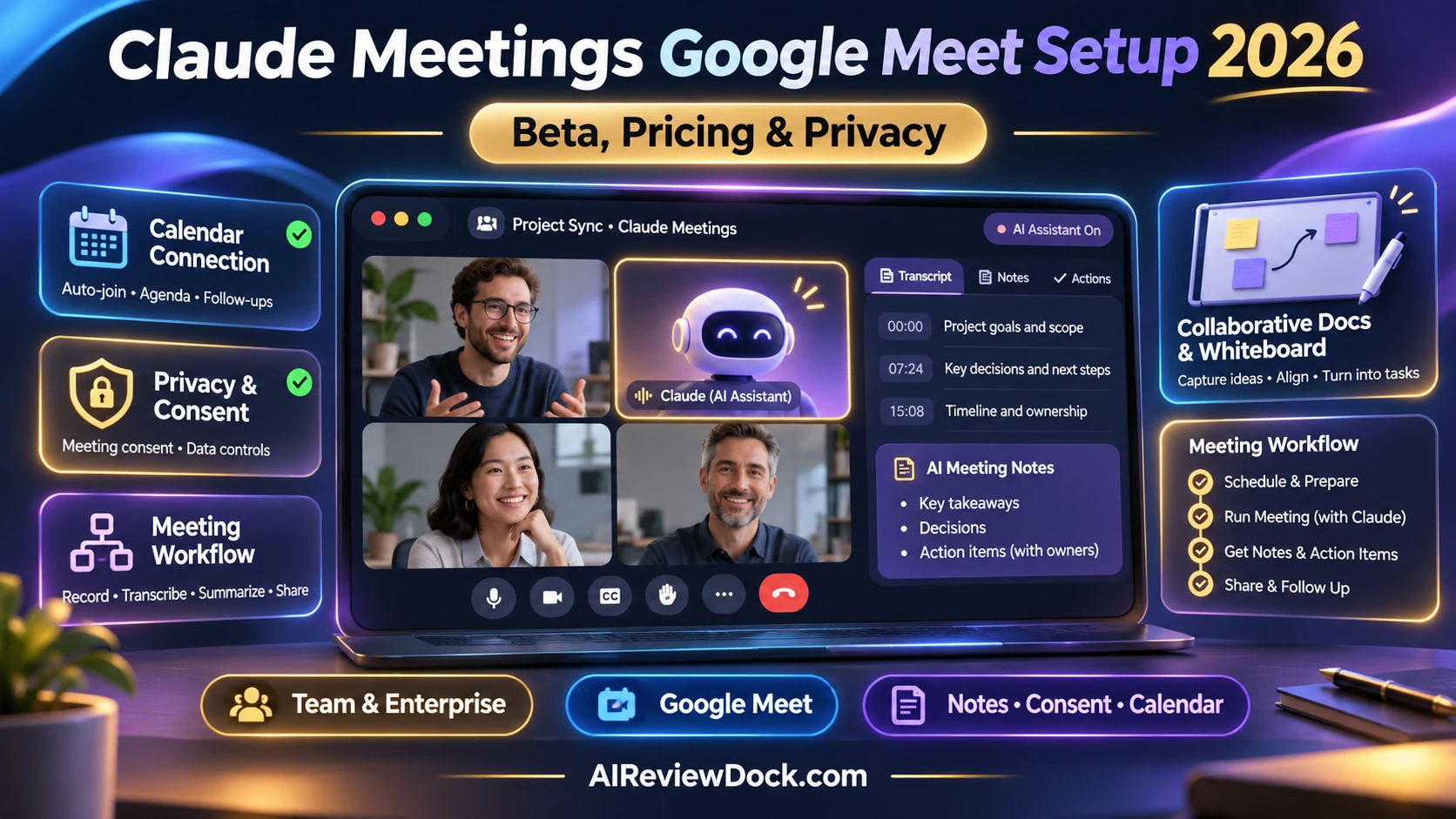
Claude Meetings Google Meet setup — Claude Meetings Google Meet setup is a new team workflow released as a beta on November 12, 2026. Claude joins as a visible participant, can transcribe and summarize a call, answers questions when invited, and creates live docs or whiteboards while a meeting is still running. Access is currently rolling out to Claude Team and Enterprise rather than all individual subscriptions. Before enabling it, a workspace owner must understand admin switches, calendar permissions, transcription consent and what happens when external guests join.
Updated November 14, 2026. We wrote this guide using the vendor’s official documents. Features and access may change during rollout; we have not run a paid hands-on benchmark.
Claude Meetings Google Meet setup: quick answer
| Question | Current information |
|---|---|
| Launch | November 12, 2026 beta |
| Plans | Claude Team and Enterprise only during rollout |
| First video platform | Google Meet |
| Calendar setup | Google Calendar connection enabled by workspace owner |
| Live artifacts | Docs, whiteboards and other supported artifacts |
| Meeting duration | Claude can remain for up to eight hours |
| Data saved | Transcript, summary and screen descriptions; no audio file |
| Meeting pricing | Notes, transcripts and basic answers included on eligible plans |
What is Claude Meetings?
First, Claude Meetings Google Meet setup is a new team workflow released as a beta on November 12, 2026. Claude joins as a visible participant, can transcribe and summarize a call, answers questions when invited, and creates live docs or whiteboards while a meeting is still running. Access is currently rolling out to Claude Team and Enterprise rather than all individual subscriptions. Before enabling it, a workspace owner must understand admin switches, calendar permissions, transcription consent and what happens when external guests join.
Above all, start by defining your task and checking that you have permission to carry it out. New AI tools may save time, but teams still need clear access rules, reliable results and named owners. Also, the vendor may not have enabled every advertised feature for every organization yet.
Claude Meetings: seven important capabilities
1. A visible bot instead of silent capture
For example, Claude appears as a participant in Google Meet and posts a notice in the call chat. Its visible status can help a team recognize when meeting transcription is active. Nevertheless, a notification is not a substitute for obtaining meaningful permission from everyone involved; legal recording and transcription rules vary by jurisdiction and by contract.
2. Google Calendar-backed meeting selection
Next, a team member opens Meetings in Claude, connects Google Calendar after organization approval and chooses an upcoming call. The option to add Claude depends on plan eligibility, workspace configuration and the invitation’s external-guest policies. Do not assume that turning on one connection makes every meeting automatically available.
3. Live questions from speech or chat
In addition, during an eligible call, someone can say Claude’s name followed by a question or type a request in Meet chat. The assistant normally responds in writing. Its answer may draw on the ongoing transcript and permitted tools, but participants should verify consequential statements rather than treat every AI response as an agreed meeting decision.
4. Docs, slides and whiteboards during the call
Moreover, a team can ask Claude to draft a document or whiteboard during the call. This lets people start work before the meeting ends. The artifact remains editable, and it should identify open assumptions and unresolved actions separately from confirmed agreements. This helps avoid generating polished but incorrect commitments.
5. Connected tools with explicit user permission
However, Anthropic says Claude can use connected tools during a meeting using the permissions of an individual who has authorized them. The product requests approval and may require speaker confirmation. Leaders should restrict which accounts may send messages or change records, and should not grant broad workflow permissions merely for convenience.
6. After-call summaries and internal sharing
Afterward, the meeting page stores notes, transcript and created artifacts. People inside the organization who are on the invite may receive a recap and can access or edit meeting outputs. External guests normally do not get the internal meeting page. Teams should still review who is invited and whether information is intentionally shareable.
7. Admin rules for guests, retention and availability
Meanwhile, on Team plans Meetings is on by default unless an owner disables it; Enterprise owners enable it for eligible roles or the organization. The beta excludes some organizations that use zero-data-retention, HIPAA-ready or customer-managed encryption setups. External guest settings and member connector permissions require deliberate organization policy.
Claude Meetings Google Meet setup: step-by-step implementation
To begin, run a small pilot with the right permissions. The steps below give you a practical checklist; they do not claim that we tested the product ourselves. Keep records of permissions, errors and the final result that a person approves.
Step 1: Confirm workspace eligibility
First, check that your organization uses an eligible Team or Enterprise plan and that your admin has enabled the feature for your role. Anthropic may roll out beta access in stages, and some compliance setups remain ineligible.
Step 2: Get consent before adding the assistant
Next, tell participants that Claude will transcribe the meeting and may store AI notes and files. Follow your organization’s consent policies and relevant legal requirements.
Step 3: Connect your Google Calendar
Then, a workspace owner first enables the calendar connection. In Claude Meetings, connect the appropriate account; review what calendar data the integration can access.
Step 4: Choose the Google Meet meeting
After that, open Meetings, select an eligible calendar event and use Add Claude. If the host receives an admission request, they can allow or decline. A declined invite is not a reason to bypass the host’s choice.
Step 5: Run a short controlled test call
For example, say the assistant’s name and ask it to capture action items. Review live chat and whether requested document creation works before using a call with external clients or sensitive details.
Step 6: Use connected tools conservatively
Meanwhile, try one low-risk operation and confirm which person’s identity and approval it uses. For anything with side effects, keep a human confirmation step and preserve a revision trail.
Step 7: Review outputs immediately after the call
Finally, open the internal meeting page, check attendance, decision wording, owners and dates. Correct errors before sharing a recap and limit access to the right audience.
Claude Meetings: plans, features and limitations compared
| Feature or tier | Availability / cost | Important note |
|---|---|---|
| Individual free/Pro/Max | Not in the announced beta | Do not expect a personal subscription alone to unlock it |
| Team plan | Included feature where available | Owner may disable it; check billing for base plan |
| Enterprise plan | Owner-enabled beta | Custom roles and security configuration may limit access |
| Transcript and notes | Included with eligible plans | Consent and data governance still required |
| Meeting-made docs/whiteboards | Free through Feb 10, 2027 | Recheck terms after promotional period |
| Connected tool actions | Can count toward usage | Organization charges may apply |
Three real-world workflows for Claude Meetings
Internal project standup
For instance, Claude can organize pending decisions and write a follow-up brief while teammates clarify assignments. A human owner should confirm every task and deadline before it enters a project tracker.
Customer discovery interview
Similarly, the tool could create a research summary if every guest has consented and the organization’s settings permit external participation. Ask open-ended questions and avoid treating paraphrases as direct customer quotes.
Remote workshop
Likewise, a shared whiteboard can list ideas and cluster them in real time. Preserve the original brainstorming discussion separately so that rejected ideas do not become accidental final decisions.
Practical safety and adoption checklist
- Confirm Team or Enterprise beta eligibility and role-based activation.
- Get everyone’s consent to the transcription before inviting the bot.
- Test external guest and one-on-one meeting rules with a non-sensitive call.
- Limit connected tools to roles that truly need them.
- Review meeting summaries for inaccurate decisions and missing participants.
- Audit access to transcripts, recaps and shared artifacts.
- Review data retention and the end date of promotional artifact pricing.
Therefore, a polished demo is only a starting point. Set clear owners, usage limits, success measures and steps for handling exceptions. Teams with high privacy or security requirements should check vendor documentation and internal policy before enabling integrations.
Related guides and alternatives to Claude Meetings
For foundational guidance on AIReviewDock.com, see AI meeting notes accuracy guide and data governance checklist for small teams. These address durable workflow principles rather than duplicating this launch announcement.
On the other hand, our separate AIReviewDock.online review site also covers adjacent tools, including ClaudeX 5.5 buyer review and NewsletterPub AI review. Those commercial products serve different use cases and should not be mistaken for the service evaluated here.
Claude Meetings Google Meet setup: frequently asked questions
Is Claude Meetings available on personal Claude Pro?
In short, anthropic’s November 12 rollout is for Team and Enterprise plans. Check later release notes for any changes.
Does Claude Meetings work with Zoom or Teams?
For now, the initial beta supports Google Meet; Anthropic may add other video platforms later, but do not assume it supports them today.
Does the assistant join automatically?
Also, you can add it manually and configure individual auto-join preferences, subject to organization rules.
Is the whole call recorded as audio?
Importantly, Anthropic says the product saves text transcripts, summaries and screen descriptions, not an audio recording.
Can outside guests read the internal meeting page?
However, external guests generally do not receive the organization’s meeting page or recap, while Claude may still transcribe their speech if the host allows it.
How much does Claude Meetings cost?
In addition, eligible Team and Enterprise plans include basic notes, transcripts and answers without connected tools. The vendor offers free artifacts for a set beta period, while connected tools can use your quota.
Can the admin disable meetings?
Yes. Team owners may turn it off; Enterprise owners manage activation and participant policies.
Can Claude send a Slack message for everyone?
Nevertheless, it uses individual member connections and permission prompts; a team should configure which tools it allows and confirm any action.
Final recommendation for Claude Meetings
Overall, Claude Meetings could make recurring internal calls more actionable when a team already pays for Claude and needs notes and editable artifacts. The benefit comes from a verified, permissioned workflow rather than automatic attendance. Pilot with an internal meeting and resolve consent, guests, data retention and connected-tool controls before scaling.
For this reason, keep a written plan and check current eligibility rules. Then test whether the workflow gives useful results while protecting consent, data and approval steps.
Official sources and methodology
Finally, primary references checked November 14, 2026: Anthropic’s official Claude Meetings setup and privacy guide and official Claude release notes for November 12. These examples explain the workflow; we do not claim to have bought the tools or used them in production.