
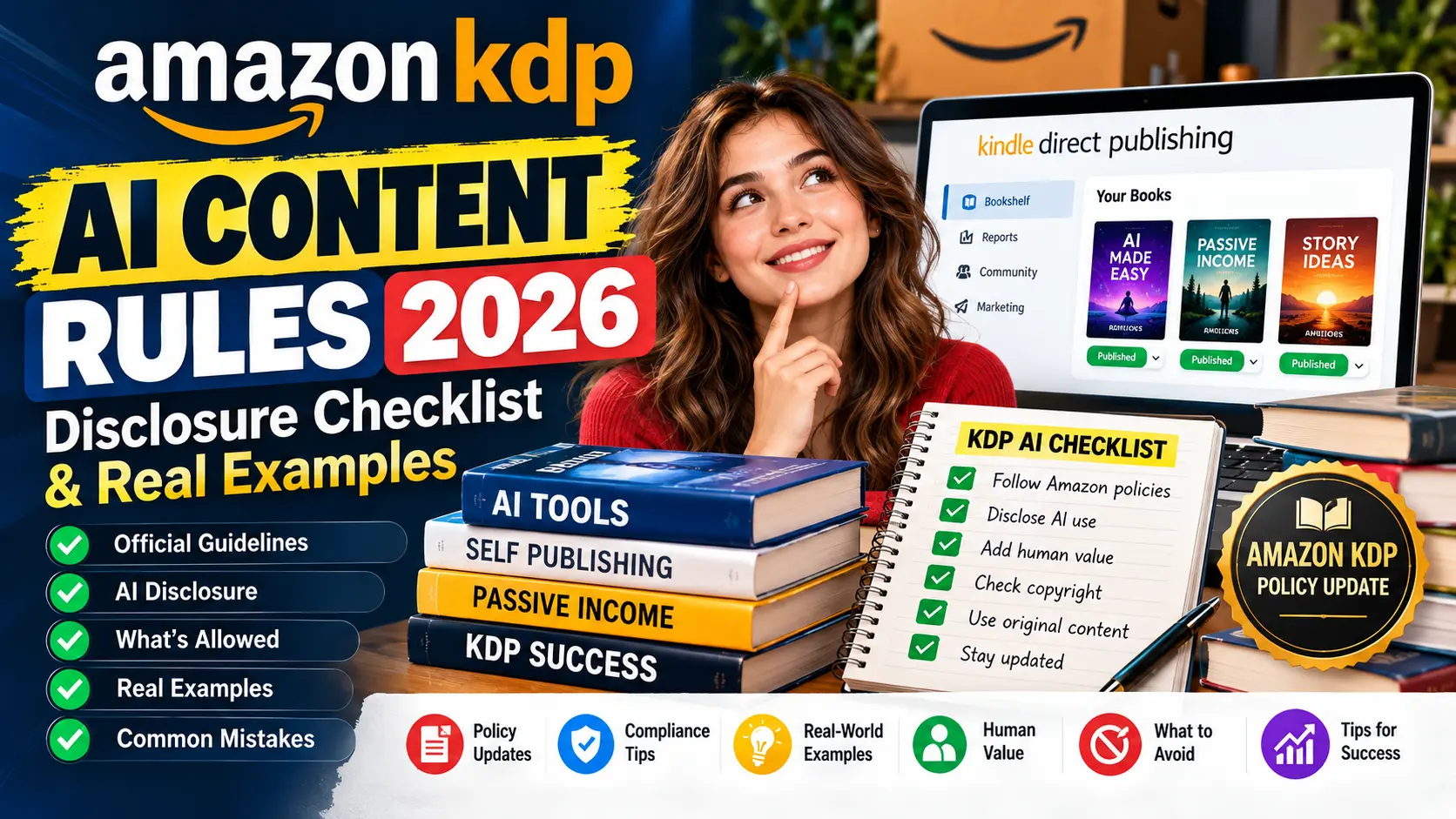
Amazon KDP AI content rules matter when artificial intelligence helps create a manuscript, book cover, illustration, or translation. In 2026, the key distinction is between AI-generated content and AI-assisted work. Amazon requires disclosure of AI-generated text, images, and translations, while AI-assisted brainstorming and editing are treated differently.
This independent guide explains Amazon’s published policy with realistic examples, a publishing checklist, and links to official resources. It is not legal advice and does not replace the current Amazon KDP Content Guidelines. Policy checked on October 13, 2026.
Amazon KDP AI Content Rules 2026: Quick Answer
| How you used AI | Typical classification | Disclosure |
|---|---|---|
| Generated book chapters or passages | AI-generated text | Required under KDP’s stated rule |
| Generated cover or interior illustrations | AI-generated images | Required, including cover artwork |
| Translated a manuscript with an AI tool | AI-generated translation | Required |
| Brainstormed ideas, but wrote the final words yourself | AI-assisted | Not required under this distinction |
| Proofread or improved text you wrote | AI-assisted | Not required under this distinction |
| Heavily edited text initially written by AI | Still AI-generated | Required; editing does not erase its origin |
This is an explanatory classification based on Amazon’s definitions, not a statement that Amazon has assessed any particular manuscript. For mixed workflows, identify exactly which components the model created.
What Does Amazon Count as AI-Generated Content?
Amazon defines AI-generated material as actual text, images, or translations produced by an AI-based tool. One frequently misunderstood detail is that the generated material does not stop being AI-generated simply because you make substantial edits afterwards. A first draft generated by an AI tool is therefore different from a draft originally written by an author and merely refined with AI suggestions.
The scope is wider than a book’s main text. AI-created cover illustrations and interior artwork are included. If you combine generated visual elements with human-made typography, retain a record of the image components that were generated. Translations created by a model also fall under Amazon’s description of AI-generated content.
What Does AI-Assisted Mean for KDP?
AI-assisted work begins with content you created yourself. Amazon gives examples including an author using AI to edit, refine, check for errors, or otherwise improve human-written content. Brainstorming ideas that you later develop into your own writing is also covered by its AI-assisted explanation.
For example, an author who writes a personal finance chapter and asks a model to identify unclear sentences is using the tool as an editor. An author who asks the model to produce a complete chapter and then rewrites half of it is starting with generated text. The same app can be used in either way; the work process determines the distinction.
When Must Publishers Declare AI Content?
According to the current KDP content policy, publishers must tell Amazon about AI-generated text, images, or translations when publishing a new book or making changes and republishing an existing one. Amazon says AI-assisted work does not require disclosure under this provision.
This is not a blanket prohibition on AI-made material, nor is it an approval guarantee. Authors remain responsible for originality, intellectual-property rights, accuracy, reader experience, and all other KDP requirements. Treat the disclosure step as one part of a larger publishing quality process.
Six AI Publishing Examples Explained
1. AI suggests a story concept
You request ten mystery story ideas and choose one. You then outline and write every chapter yourself. That fits Amazon’s description of AI-assisted brainstorming, provided your actual prose was not generated by the model.
2. AI produces a manuscript draft
You use a book-writing tool to generate the first 20,000 words, followed by extensive human revision. Amazon’s definition still treats the model-created material as AI-generated. Review the manuscript for repeated paragraphs, factual errors, unintentional similarities, and rights issues before submission.
3. AI makes the book cover
You generate the main illustration using an image tool, then add the title and author name manually in a graphics editor. The AI-generated image component is covered by Amazon’s disclosure requirement. Also check whether your license permits commercial publishing and whether the illustration conflicts with anyone else’s rights.
4. AI corrects spelling and style
You wrote all the text, then accepted grammar and clarity suggestions. This resembles Amazon’s examples of AI-assisted editing. You still need to review every automated suggestion, particularly where it changes factual meaning.
5. AI translates an existing book
A model turns your English manuscript into another language. Under Amazon’s guidance, the resulting translation is AI-generated material even if you later correct it. Human language review is especially valuable for tone, terminology, and cultural context.
6. A book combines human writing and AI artwork
You write the manuscript, generate six illustrations, and use AI to suggest keywords. You should distinguish the AI-generated illustrations from the original human-written prose and disclose accurately. A component-level record helps explain the mixed workflow.
11-Point Amazon KDP AI Publishing Checklist
- Inventory the content: identify manuscript text, cover art, interior images, translations, captions, and descriptions.
- Record creation methods: note what was human-written, AI-generated, or AI-assisted.
- Classify each component: do not assume that any AI involvement automatically means generated content.
- Check permissions: verify rights for quotes, photos, model output, trademarks, and likenesses.
- Verify factual claims: check names, citations, figures, instructions, and references against reliable sources.
- Read the entire manuscript: remove contradictions, repetition, missing passages, and nonsensical transitions.
- Check continuity: for connected books, verify recurring characters, dates, settings, and unresolved plot threads.
- Validate file formats: use the current KDP ebook format guidelines.
- Preview the reader experience: test headings, table of contents, images, and page breaks.
- Answer KDP’s disclosure questions accurately: review them again whenever the manuscript or illustrations change.
- Keep evidence: retain original drafts, export samples, licenses, editing notes, and quality-check records.
Why Disclosure Does Not Guarantee Book Approval
Amazon evaluates more than the presence or absence of AI disclosures. Its Guide to Kindle Content Quality addresses problems ranging from misleading or unusable material to formatting defects. Correctly disclosing a generated chapter does not make false information, unreadable images, or broken navigation acceptable.
The software’s promise of an instant ‘KDP-ready’ file should therefore be treated as an advertised capability, not a proven result. Even an ebook that opens in a text editor may render differently on a phone, Kindle device, or tablet. Check the converted files in the reading environment before assuming the project is complete.
How to Preview an AI-Assisted eBook Before Publishing
Amazon’s eBook Manuscript Formatting Guide and Upload and Preview Book Content documentation describe how to evaluate files. A simple process is to open the finished ebook in Kindle Previewer or KDP’s Online Previewer, change the simulated device, and look through the entire book.
- Inspect the opening pages, chapter breaks, and end matter.
- Use the clickable table of contents rather than assuming its links work.
- Check images at smaller screen sizes and inspect any text embedded in illustrations.
- Look for blank pages, odd indentation, clipped tables, broken characters, and repeated passages.
- Fix the source file, regenerate the export, and run the preview again.
A quick sample check is not a replacement for full proofreading. If you later publish an updated edition, reassess the disclosure and quality requirements for the new files.
Choosing AI Book Software Without Falling for Publishing Claims
Book-production products sometimes bundle outlining, drafting, image generation, cover layout, metadata suggestions, and publishing exports into one sales pitch. Those are separate functions with separate risks. Before buying, request a sample manuscript, verify the exact editable export, check commercial-use terms, and understand the word or credit limits in the entry plan.
Series publishers should also investigate whether a tool can keep facts consistent across multiple titles. Our BookSeries AI Review explains the product’s advertised series workflow and the questions a buyer should ask about continuity, editing, and pricing. For the budget side, see our AI lifetime deals vs subscriptions guide. Neither a bargain price nor an ‘unlimited’ promise replaces quality control.
Common Amazon KDP AI Mistakes to Avoid
- Assuming all AI brainstorming must be declared as AI-generated content.
- Assuming substantial editing turns model-created paragraphs into AI-assisted writing.
- Forgetting disclosure of generated cover or interior images.
- Confusing a software seller’s advertising with an official Amazon policy.
- Trusting claims of automatic royalties, automatic approval, or guaranteed originality.
- Submitting files without checking them in Kindle Previewer.
If you are publishing interactive ebooks rather than standard manuscripts, our ClawBooks AI pricing breakdown compares its bundle tiers and what each one includes.
Frequently Asked Questions About Amazon KDP AI Content Rules
Does Amazon KDP ban AI-generated books in 2026?
Its current content guidelines describe disclosure and responsibility requirements rather than a blanket ban on all AI-generated material. Content that violates other KDP rules can still be rejected or removed.
Do AI-generated covers need disclosure?
Yes. Amazon explicitly includes cover images and interior images in its guidance on AI-generated content.
If I rewrite an AI-generated chapter, does the classification change?
Not automatically. Amazon says actual AI-generated content remains AI-generated even after substantial editing.
Do I need to disclose proofreading with an AI tool?
If you authored the material yourself and only used AI to edit or error-check it, Amazon’s current definition treats that as AI-assisted, which does not require AI-content disclosure.
Is an EPUB export automatically ready for KDP?
No. Check the latest accepted formats, technical requirements, visual layout, and content quality before uploading any exported file.
Final Verdict: Be Accurate About Origin and Careful About Quality
The practical rule is to identify who created each part of the book, accurately disclose what the model actually generated, and review the finished work like a publisher. The best AI writing workflow is the one that leaves you with editable files, clear rights, and a reading experience you can confidently stand behind.
Official sources: Amazon KDP Content Guidelines · Guide to Kindle Content Quality · Online Previewer and Quality Check. Last editorial policy check: October 13, 2026.